

[ad_1]
Myanmar’s army normally marks Armed Forces Day with a grand parade within the nation’s capital as commander-in-chief Senior Basic Min Aung Hlaing – in full regalia – inspects his troops from an open-topped four-wheel drive.
Final yr, because the generals celebrated the event with its traditional pomp, safety forces throughout the nation launched deadly assaults towards protesters against the February coup, killing some 160 civilians in a single day.
This yr, they’re dealing with accusations from the United Nations and others of committing atrocities that quantity to crimes towards humanity. America, Britain and Canada all introduced new sanctions on Saturday – concentrating on arms sellers and the air drive.
However the army has not let its worldwide isolation dampen the temper.
It has been getting ready for Sunday’s parade for a number of weeks, and it seems Russia – a fellow outcast after its February invasion of Ukraine – will as soon as once more be an honoured visitor.
“[Russia and Myanmar] have an in depth and crucial relationship. Russia has been a gradual provider of weapons and the junta has travelled to Moscow to see the weapons firsthand and meet with Russian army officers and arms sellers,” mentioned Tom Andrews, the UN Particular Rapporteur on human rights in Myanmar.
Together with Russian Deputy Defence Minister Alexander Fomin, who attended the parade in 2021, a number of Russian pilots are set to supply an illustration of the brand new fighter jets that the army lately bought, underlining the regime’s more and more shut relationship with Moscow, its greatest supply of arms.
Certainly, the Myanmar army was one of many few that got here to the Kremlin’s defence after the invasion of Ukraine, describing the assault as an “applicable motion” to information community VOA Burmese.
In a report to the UN Human Rights Council in late February, Andrews recognized Russia as certainly one of three states – the others being China and Serbia – to have provided weapons to Myanmar for the reason that coup regardless of their use towards civilians.
Whereas Russian and Chinese language arms exports have proven no indicators of slowing, Serbia, which delivered rockets and ammunition shortly after the army seized energy, has since mentioned that it’s going to halt all future gross sales.
Belarus, India, Pakistan, Ukraine, South Korea and Israel had been additionally flagged within the report, having offered army tools to Myanmar earlier than the coup.
The Stockholm Worldwide Peace Analysis Institute, which supplies information on the worldwide arms commerce, reveals arms gross sales between Myanmar and these international locations peaking round 2018-2019, however truly fizzling out shortly earlier than the generals seized energy.
Different international locations have additionally not ended ties, with Japan persevering with to supply coaching to officers and cadets, in keeping with Human Rights Watch.
‘Shut cooperation’
Nonetheless, whereas the Myanmar army’s arsenal consists of arms and tools from quite a few international locations, Russia stays its prime worldwide defence accomplice.
Justice for Myanmar (JFM), a rights advocacy group that investigates army investments within the nation, on Sunday revealed a listing of 19 Russian arms suppliers which have supplied the army with tools, calling for them to be sanctioned.
Whereas the relationships are longstanding, they’ve change into particularly essential to the regime for the reason that coup when the army toppled Myanmar’s elected authorities and detained civilian chief Aung San Suu Kyi.
Since then, the army has cracked down on the Myanmar folks in a collection of violent assaults, killing a minimum of 1,707 folks as of March 25, in keeping with the Help Affiliation for Political Prisoners. It additionally faces civilian insurgent teams and rising resistance in border areas the place it has been battling ethnic armed teams for many years.
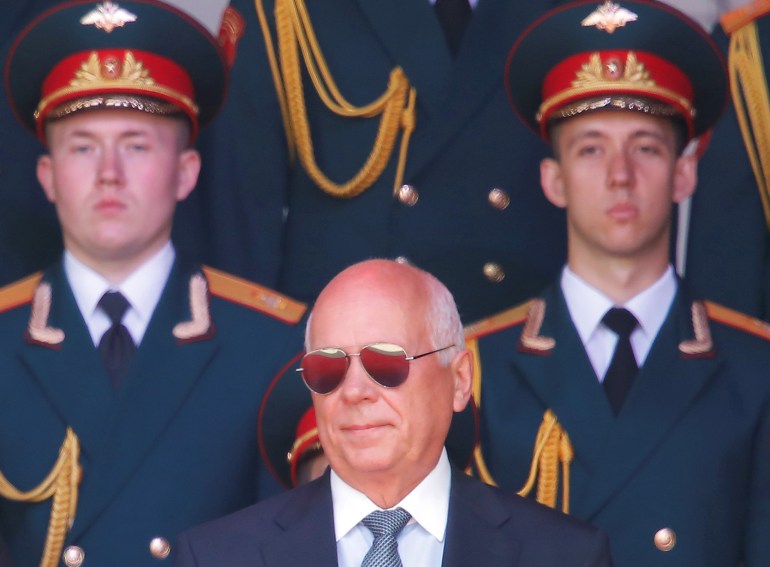
On the prime of Russia’s checklist of state-run defence conglomerates is Rostec, a posh internet of 15 holding firms and 70 entities, a lot of which have provided the Myanmar army with tools comparable to components for fighter jets, fight helicopters and surface-to-air missiles.
Considered one of Rostec’s largest subsidiaries, Rosoboronexport, has despatched a number of shipments of arms and tools, together with artillery, to the army for the reason that coup and has beforehand touted the significance of its relationship with Myanmar.
The top of Rosoboronexport mentioned in July 2021 that it enjoys “shut cooperation” with Myanmar’s armed forces and earlier this month, a army delegation travelled to Russia to attend an arms exhibition the place they met a senior govt from Rosoboronexport to debate “enhancing cooperation,” in keeping with Myanmar’s state-run media.
Army officers have additionally reportedly been assembly Russian representatives inside Myanmar.
Members of the Eurasian Financial Union, which has 5 member states together with Russia and Belarus, met with the army within the capital Naypyidaw final week to debate “bilateral commerce promotion and defence providers”, in keeping with Myanmar state-run media.
A minimum of three officers from Rostec, together with a chief professional from Rosoboronexport, are additionally at present in Myanmar, a supply with information of the scenario who declined to be named advised Al Jazeera. Rosoboronexport operates an workplace in Myanmar.
“Rostec is an important Russian firm for the Myanmar army, offering a big selection of arms and tools, together with the fighter jets and helicopter gunships that the Myanmar army are counting on in indiscriminate air strikes across the nation,” JFM spokesperson Yadanar Maung advised Al Jazeera.
Together with Rosoboronexport, JSC Tactiles Missiles Company can also be a significant provider of air drive expertise to Myanmar’s army, transport aircraft-guided weapons preparation techniques on to the workplace of the air drive chief in 2019. One other firm, JSC Concern VKO, also called Almaz-Antey, has additionally supplied the Myanmar army with components for the upkeep and restore of surface-to-air missiles.
The final cargo was obtained almost three weeks after the 2021 coup, in keeping with the JFM report.
Suspicion of China
The army’s curiosity in strengthening its relations with Moscow is a part of an effort to diversify its checklist of defence companions in addition to distance itself from China, in keeping with David Mathieson, a number one impartial analyst on Myanmar.
“[The military] recognises that they want an ally that’s not China. It’s a part of a longstanding view of worldwide relationships that the army has, the place they don’t like counting on only one main actor,” Mathieson advised Al Jazeera.
Mathieson additionally notes that the gradual pivot away from Beijing may very well be as a result of sale of “substandard” Chinese language tools that, whereas typically cheaper than Russian arms, is decrease in high quality and extra prone to want common repairs.
Defence relations with Russia are additionally much less complicated than with China.

The 2 international locations would not have a typical land border and Moscow’s arms dealings are virtually completely with the army, in contrast to China which has additionally offered weaponry to different teams inside Myanmar, together with these which might be at present preventing towards the army.
Russia additionally affords the Myanmar army more practical air fight techniques – with aerial assaults a key a part of the generals’ technique towards their opponents – whereas China’s capabilities are extra targeting land and sea.
“Russia might be their closest provider to the type of issues that they want, which is helicopter gunships and small assault plane,” mentioned Mathieson.
The army’s assaults, notably air strikes and the usage of helicopter gunships, have displaced greater than 440,000 folks, the UN mentioned in March.
‘They want one another’
Analysts say that the energy and significance of Russia’s relationship with the Myanmar army imply that, at the same time as Moscow’s consideration and sources are diverted to its personal warfare efforts in Ukraine, the arms circulate between the 2 international locations is prone to stay robust.
“If something, as Russia continues to change into extra remoted, its relationship with Myanmar might change into that rather more sturdy as different companions draw back,” mentioned Jon Grevatt, the top of Asia-Pacific information at Janes, a defence intelligence organisation.
“Additionally, due to COVID-19, international locations like [Myanmar] are in a greater place to take care of a restriction or disturbances within the provide chain from Russia as a result of there may be an emphasis on creating native functionality to provide spare components domestically and even present upkeep domestically as effectively.”
Myanmar’s defence price range is roughly $2.5bn per yr, of which solely about $500m is allotted for defence procurement – a fraction of the particular value of the Russian arms. As an example, Sukhoi Su-30 fighter jets which have been utilized in assaults in northern Myanmar have an estimated checklist value of $47m every – almost a tenth of its complete price range – though the precise value varies in keeping with the yr and mannequin.
youtube https://www.youtube.com/watch?v=IVrhmN2q7cs
Provided that the army can’t afford to purchase all of its army tools from Russia in {dollars}, there’s a excessive probability its purchases are supported by the switch of uncooked supplies, together with gem stones and timber, in keeping with Grevatt. It’s an method that additionally makes it simpler for either side to avoid worldwide sanctions.
The measures to this point appear to have had little critical impact, in keeping with the Andrews’ February UN report, however that has not stopped calls for extra arms embargoes and sanctions on each international locations.
Specialists say it might be unlikely to hinder the circulate of arms from Russia to Myanmar, nonetheless.
“[Russia or Myanmar] gained’t pull out. That is one thing that might be by thick and skinny. They want one another they usually know that they’re stronger collectively. They assist one another – [Myanmar] can get army tools, and Russia can get uncooked supplies,” mentioned Grevatt.
“When your mates are dwindling by the wayside, those that you just’ve acquired left routinely change into extra essential.”
[ad_2]








Leave a Reply