

[ad_1]
Whether or not you make lower than $45,000 yearly, or greater than $220,000, there are some key factors to bear in mind when deciding the place to place your cash

Evaluations and suggestions are unbiased and merchandise are independently chosen. Postmedia might earn an affiliate fee from purchases made by means of hyperlinks on this web page.
Article content material
By Julie Cazzin with Allan Norman
Commercial
This commercial has not loaded but, however your article continues under.
Article content material
Q: That is the time of yr once I at all times have a look at the cash in my financial savings account and attempt to decide if I’ve sufficient to make a registered retirement financial savings plan (RRSP) or a tax-free financial savings account (TFSA) contribution. With two youngsters and a mortgage, cash is usually tight and I can solely do one or the opposite. How do I am going about deciding which is greatest for me? And if I ever manage to pay for to do each — one thing that can doubtless occur shortly after my mortgage is paid off — does it make sense to take action? — Leona
Article content material
FP Solutions: That’s an excellent query, Leona, and I do know from expertise that lots of people have this conundrum. Nevertheless it all begins by understanding the maths. There are different components concerned, however realizing the maths will take you a great distance towards making your resolution.
Commercial
This commercial has not loaded but, however your article continues under.
Article content material
Earlier than we get to the maths, bear in mind an RRSP contribution is earlier than tax and withdrawals are taxable, whereas a TFSA contribution is after tax and withdrawals are tax free. This is a vital distinction, as you will notice shortly.
Additionally, an RRSP offers you with a tax refund, which you need to consider as an interest-free mortgage that’s yours to do with what you want, however needs to be paid again whenever you withdraw out of your RRSP or registered retirement earnings fund (RRIF).
Now, to the maths.
The accompanying desk compares the after-tax outcomes of investing in an RRSP towards a TFSA funding incomes 5 per cent over 20 years. Which funding account do you assume will do higher, assuming your marginal tax fee (MTR) stays the identical?
Commercial
This commercial has not loaded but, however your article continues under.
Article content material

The reply is in row six: In case your MTR stays the identical and each accounts earn the identical fee of curiosity, there isn’t any distinction between investing in an RRSP or TFSA.
Row seven reveals that if in case you have a decrease MTR on the time of withdrawal than whenever you contributed, the RRSP beats the TFSA. Many individuals will discover themselves on this scenario after they retire or if they’re a part of a pair and are in a position to pension break up.
Row eight reveals the alternative. In case your MTR is greater on the time of withdrawal than on the time of contribution, then the TFSA is healthier.
Row 9 extra doubtless represents most individuals’s property taxes. In Ontario, your MTR is 53.53 per cent if in case you have a taxable earnings or property of greater than $220,000. Only a reminder that not all earnings is taxed at 53.53 per cent — solely the earnings over $220,000.
Commercial
This commercial has not loaded but, however your article continues under.
Article content material
To keep away from the massive tax chew, it might make sense to attract surplus earnings out of your RRIF even in the event you don’t want it to assist your way of life. That shouldn’t be an issue in case your MTR was 40 per cent on the time of contribution and it’s 40 per cent on the time of withdrawal. The maths says it’s no totally different than if it was a TFSA funding (although the Outdated Age Safety (OAS) clawback could also be a problem).
The issue is you want one other funding tax shelter. If you’re drawing surplus earnings from a RRIF then presumably you don’t want it — it’s surplus. You probably have kids or grandchildren, take into account contributing to their registered schooling financial savings plans (RESPs), TFSAs or RRSPs.
That’s the textbook rationalization of the RRSP math, however let’s get reasonable.
Commercial
This commercial has not loaded but, however your article continues under.
Article content material
Discover in row three that the RRSP funding was $7,142 (which is earlier than tax) and the TFSA funding was $5,000 after tax. That’s the correct option to do the comparability, however is that how most individuals make investments? You probably have $5,000 to spend money on an RRSP or TFSA, do you cease to assume, “How a lot did I’ve to earn to get my $5,000?” after which contribute the bigger grossed-up quantity to your RRSP?
Most individuals don’t.
Right here is the system to do the calculation, in the event you’re : investment quantity/(1-MRT) = pre-tax earnings.
Additionally word {that a} small RRSP mortgage is an effective technique to gross up your RRSP funding. Repay the mortgage when the RRSP tax refund comes.
If you happen to don’t use the mortgage technique, some buyers will make investments the RRSP tax refund, however the tax refund on $5,000 is smaller than the gross-up quantity, so it’s not as efficient as grossing up your preliminary funding.
Commercial
This commercial has not loaded but, however your article continues under.
Article content material
The second desk reveals the after-tax outcomes of investing the identical quantity in an RRSP or a TFSA, and investing the refund versus not investing the refund.
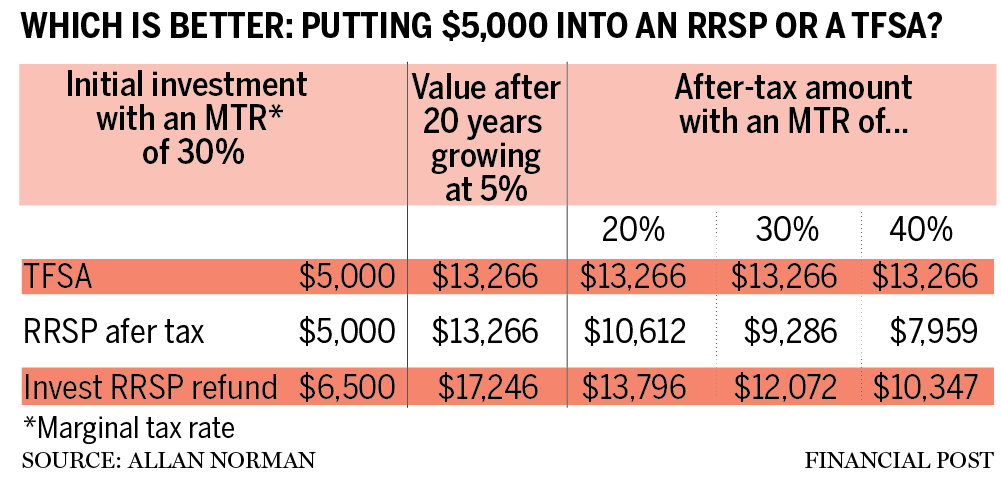
As you most likely guessed, you might be greatest off investing in a TFSA in virtually each case. The slight exception may be seen in row three, when the RRSP tax refund was invested and the MTR on the time of withdrawal was decrease than it was at time of contribution.
At this level, it’s possible you’ll be questioning why you need to ever take into account investing in an RRSP. One motive is you possibly can contribute extra to an RRSP than a TFSA, however listed here are another key issues to contemplate primarily based on earnings solely.
-

FP Solutions: Does it make sense to take a pension payout and spend money on a farm?
-

FP Solutions: Can I retire in 15 years regardless that I’m nonetheless paying off my mortgage?
-

FP Solutions: When’s the very best time to make my final RRSP contribution?
-

FP Solutions: Is it price it leveraging my HELOC to spend money on dividend-paying ETFs?
Commercial
This commercial has not loaded but, however your article continues under.
Article content material
Incomes lower than $45,000 and an approximate MTR of 20 per cent
The TFSA is probably going the most suitable choice as a result of your withdrawal MTR doubtless gained’t be decrease than your MTR at time of contribution; your tax-free withdrawals in retirement gained’t negatively affect authorities advantages such because the Assured Revenue Complement (GIS), or tax credit such because the age credit score; in the event you begin investing younger sufficient, the utmost TFSA contribution restrict might be all you could save to assist your present way of life in retirement when mixed with Canada Pension Plan (CPP) and OAS.
An exception could also be in case you are making an attempt to scale back your taxable earnings to assert extra of the Canada Youngster Profit (CCB).
Incomes between $45,000 and $90,000 with an approximate MTR of about 30 per cent
Commercial
This commercial has not loaded but, however your article continues under.
Article content material
That is the possibly/maybe-not vary for RRSP contributions. Are you going to gross up your RRSP contribution? How a lot do you could save for retirement? Is it greater than what TFSA contribution limits allow? Will your MTR be decrease whenever you retire?
Typically, most individuals on this earnings vary will probably be contributing to RRSP accounts. The upper your earnings on this vary, the extra that RRSP contributions make sense.
If you’re simply above the $45,000 earnings or MTR degree, take into account contributing solely sufficient to an RRSP to drop you into the decrease tax bracket.
Incomes over $90,000 and an MTR over 40 per cent
At this earnings degree your focus could also be on maximizing your RRSP contributions and utilizing up all previous RRSP contribution room earlier than making TFSA contributions. A objective could also be to compensate for your RRSPs after which use the tax refunds to maximise your TFSA.
Commercial
This commercial has not loaded but, however your article continues under.
Article content material
There are various different components to consider, comparable to earnings splitting, the RRSP House Patrons’ Plan and Lifelong Studying Program (LLP), and the affect on authorities advantages and credit.
My suggestion is that you just talk about your scenario with a planner in case you are unsure if try to be contributing to an RRSP or a TFSA. Or determine what you assume is greatest to your scenario and make a contribution to a kind of plans. You gained’t be making a foul resolution and it’s higher to contribute to both one fairly than do nothing in any respect.
Allan Norman, M.Sc., CFP, CIM, RWM, is each a fee-only licensed monetary planner with Atlantis Monetary Inc. and a totally licensed funding adviser with Aligned Capital Companions Inc. He may be reached at www.atlantisfinancial.ca or alnorman@atlantisfinancial.ca. This commentary is supplied as a normal supply of data and is meant for Canadian residents solely.
_____________________________________________________________
For extra tales like this one, enroll for the FP Investor e-newsletter.
______________________________________________________________
Commercial
This commercial has not loaded but, however your article continues under.

[ad_2]








Leave a Reply