
[ad_1]
Because the United Nations Safety Council debated Russia’s transfer to recognise the independence of two breakaway areas in Ukraine and to deploy “peacekeepers” there, a speech by Martin Kimani, Kenya’s UN ambassador, caught the eye of many. It’s being described as among the finest speeches delivered on the discussion board. In it, Kimani eloquently expressed Kenya’s opposition to Russia’s actions and to the concept of utilizing drive to alter borders left behind by collapsing empires.
In not so many phrases, the Kenyan envoy asserted that Russian President Vladimir Putin, who in a rambling speech simply hours earlier than had bemoaned the dismemberment of the USSR in 1991, may take a lesson from the African expertise.
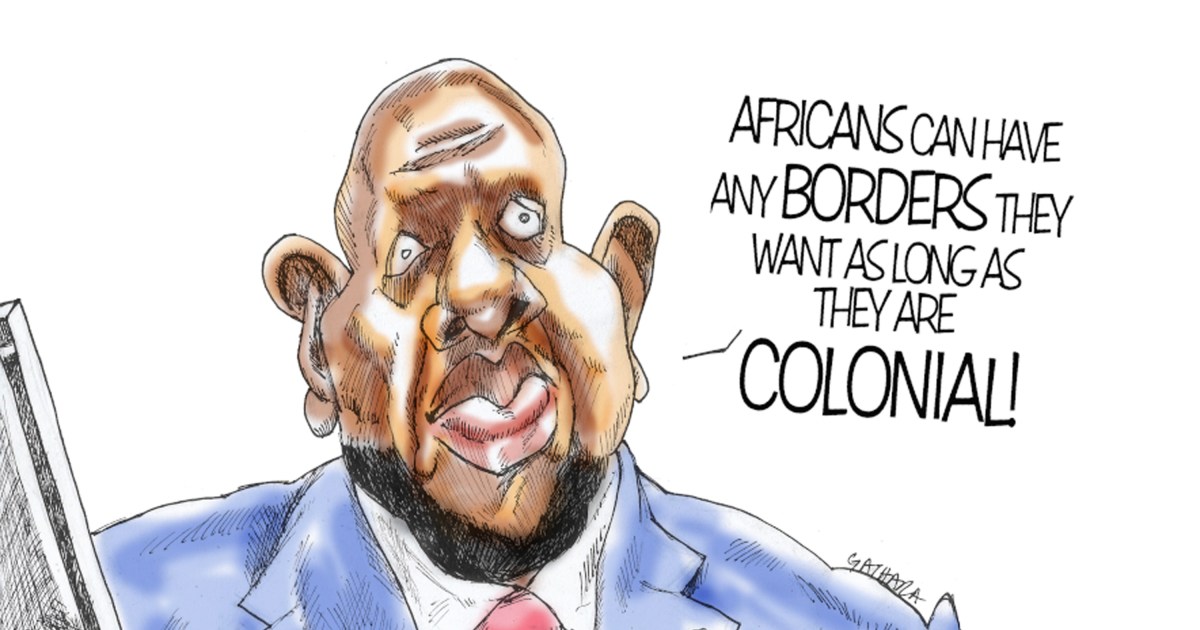
“Kenya and nearly each African nation was birthed by the ending of empire. Our borders weren’t of our personal drawing,” he stated. “Had we chosen to pursue states on the idea of ethnic, racial or spiritual homogeneity, we might nonetheless be waging bloody wars these many many years later. As a substitute, we agreed that we might accept the borders that we inherited. However we might nonetheless pursue continental political, financial and authorized integration. Somewhat than kind nations that appeared ever backwards into historical past with a harmful nostalgia, we selected to stay up for a greatness none of our many countries and peoples had ever recognized.”
It was a masterful efficiency, however one that’s fairly troubling for its seeming valorisation of the colonial order that continues to this present day. Africans, in line with Kimani, had not recognized greatness earlier than the white man arrived and together with his departure, had apparently left them with the framework to pursue it.
The Constitution of the Organisation of African Unity (OAU) to which he referred established the inviolability of colonial borders, to a big extent placing to mattress a debate over tips on how to undo the colonial legacy – the meeting of 32 heads of state and authorities who signed it in Could 1963 within the Ethiopian capital Addis Ababa principally determined to not.
Based on Kimani, this was “not as a result of our borders happy us, however as a result of we needed one thing larger cast in peace”. Renegotiating the boundaries and the colonial programs constructed on them was seen as not solely a recipe for chaos, but additionally a barrier to “one thing larger” for the rulers (the preamble to the Constitution prophetically begun with the phrases “We the heads of state” not “We the individuals”).
Because the late Tanzanian chief, Mwalimu Julius Nyerere, would later comment, as soon as “you multiply nationwide anthems, nationwide flags and nationwide passports, seats on the UN, and people entitled to 21 weapons salute, to not converse of a number of ministers, prime ministers, and envoys, you’ve a complete military of highly effective individuals with vested pursuits in holding Africa balkanised”.
Independence was thus little greater than a coat of paint. Like their colonial predecessors, the shiny new states would proceed to be constructed on extraction from the Africans. Independence would imply freedom for the state, not for the individuals. Together with “respect for the sovereignty and territorial integrity of every state and for its inalienable proper to unbiased existence”, the OAU Constitution additionally enshrined the precept of “non-interference within the inside affairs of States” which meant rulers may do as they wished throughout the colonial borders.
In 2013, Kimani’s boss, President Uhuru Kenyatta, who, together with Deputy President William Ruto, had taken workplace whereas charged with crimes towards humanity in relation to the 2007-08 post-election violence, efficiently pushed for reassertion of impunity for heads of state on the OAU’s successor, the African Union.
Kimani’s predecessor, Ambassador Macharia Kamau, additionally introduced the argument for impunity to the UN, urging the Safety Council to void Kenyatta’s prosecution. At one operate, he would even assert that folks kicked out of their properties by the election violence had benefitted from their displacement. “They’ve come out approach forward,” he stated, arguing that lots of these subsequently resettled by the state had been squatters earlier than the violence.
So when Kimani speaks of “complet[ing] our restoration from the embers of useless empires in a approach that doesn’t plunge us again into new types of domination and oppression,” the very fact is the chance to take action was scuttled way back by the individuals he represents on the UN – “we the Heads of State”.
Additional, whereas he’s proper to sentence Russia for its violations of Ukrainian sovereignty, the stench of hypocrisy permeates his speech. In spite of everything, in October 2011, Kenya itself massed troops and gear on the border with its neighbour, Somalia, and sought a pretext to ship them throughout, regardless of dire warnings from the West. Thus far, the nation has refused to adjust to a ruling from the Worldwide Court docket of Justice on the maritime border with Somalia, preferring as an alternative to withdraw from the courtroom.
That Kimani’s speech has garnered reward from former colonisers who prefer to faux they had been doing Africans a favour ought to thus come as no shock. To make certain, Russia wanted to be condemned and the issues he stated in that regard wanted to be stated. Solely he stated way more than he ought to have and, in any case, Kenya was maybe not the very best nation to make the argument.
The views expressed on this article are the creator’s personal and don’t essentially mirror Al Jazeera’s editorial stance.
[ad_2]




Leave a Reply