

[ad_1]
Medan, Indonesia – Every day, Siti Rohani fries a whole bunch of conventional Indonesian snacks at her roadside stall in Medan, North Sumatra, together with three sorts of doughnuts, fried tempeh and tofu, banana fritters, spring rolls and curry puffs.
All that frying means Rohani goes via quite a lot of cooking oil – as much as 5 litres (169 fluid ounces) a day.
The one drawback for Rohani is that cooking oil is turning into more and more troublesome to pay money for amid continual shortages throughout the archipelago.
After hovering costs of crude palm oil prompted costs of cooking oil to spike greater than 50 p.c, Indonesia’s authorities in February capped the value of a litre of oil at 14,000 Indonesian rupees ($0.93). To restrict shortages, authorities additionally started limiting prospects to 2 litres (68 fluid ounces) of oil per buy.
“I needed to go throughout city from one place to a different to purchase one other litre or two of oil, or to search out out that the subsequent place had offered out utterly,” Rohani informed Al Jazeera. “It simply made all the things even tougher.”
The worth cap, which has since been lifted, additionally had one other undesired aspect impact, in line with Posman Sibuea, a lecturer in meals know-how at Santo Thomas Catholic College in Medan.
“What occurred was that cooking oil distributors didn’t need to promote their oil at such a low value, in order that they began hoarding it,” he informed Al Jazeera. “Really, there are shares of cooking oil everywhere in the nation, however we simply don’t know the place they’re.”
In current months, the value of crude palm oil used has surged by as much as 40 p.c, the results of a confluence of things, together with Russia’s invasion of Ukraine, which provides the vast majority of Europe’s sunflower oil. With the Ukrainian sunflower oil provide disrupted by the battle, demand for different oils like palm oil has soared.
The COVID-19 pandemic additionally affected harvests in palm oil-producing international locations comparable to neighbouring Malaysia, as migrants who normally work on the plantations had been locked in another country.
Indonesia is the world’s largest producer and exporter of palm oil on this planet, and manufacturing within the nation far outweighs home demand. Authorities laws, nonetheless, solely require that 20 p.c of manufacturing stays at dwelling, that means the remainder might be exported overseas.
There may be additionally the difficulty of who truly owns Indonesia’s oil palms.
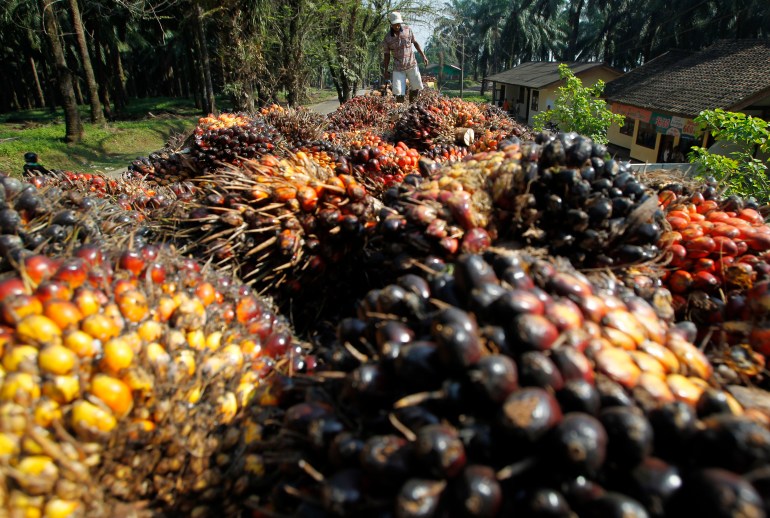
“The large drawback with palm oil is that almost all of oil palm plantations in Indonesia are owned by only some individuals, perhaps 20 at most,” Uli Arta Siagian, a forestry and plantations campaigner at environmental non-profit WALHI, informed Al Jazeera.
“These individuals don’t simply personal the plantations both, but additionally the whole trade infrastructure such because the factories and all the things else. So that they have a monopoly on the trade and a monopoly on the value of palm oil.”
Indonesia produced 44.8 million tonnes of crude palm oil in 2020, in line with knowledge from the Indonesian Bureau of Statistics (BPS), 60 p.c of which was produced by personal firms and 34 p.c by particular person farmers.
The remaining 6 p.c was produced by state-owned firms.
That 12 months, Indonesia exported greater than $18bn price of palm oil, in line with BPS knowledge.
“In Indonesia, cooking oil factories don’t normally produce their very own palm oil, in order that they have to purchase it from oil palm producers within the type of crude palm oil,” mentioned Sibuea.
“Producers can promote the palm oil at no matter value they need, and as palm oil costs elevated globally, it grew to become harder for cooking oil factories to purchase the uncooked product. That is without doubt one of the key issues, this connection between the palm oil plantations and the cooking oil factories.”
In mid-March, the Indonesian authorities determined to greater than double the utmost export levy on palm oil exports to $375 per tonne as a part of a plan to subsidise costs and distribute greater than 200 million litres (6763 fluid ounces) of the product throughout the nation every month.
On Tuesday, authorities introduced the launch of a money switch scheme providing handouts of 300,000 Indonesian rupees ($20) to assist lower-income residents and restauranteurs buy oil.
Rohani mentioned she had heard in regards to the scheme however was unclear in regards to the particulars.
“I’d like to use, in fact, if I fulfil the factors,” she mentioned.

Amid the shortages, some enterprising Indonesians have additionally taken to purchasing up as a lot cooking oil as doable and promoting it on the black market at extremely inflated costs to determined prospects. In East Kalimantan, a province in Indonesian Borneo, two girls died after queueing for hours within the sizzling solar to get their palms on the meagre provides of cooking oil obtainable at native mini-markets.
Some Indonesians have questioned why the nation is so depending on cooking oil, together with, most prominently, former Indonesian President Megawati Soekarnoputri.
“The issue isn’t about cooking oil being costly. I’ve stopped to suppose, do women simply fry their meals every single day? To the purpose that they’re preventing about cooking oil?” Soekarnoputri mentioned final month throughout an occasion about childhood stunting.
“Is there no solution to boil or steam or make rujak [Indonesia fruit salad]? These are Indonesian dishes. Why are individuals complicating this?”
To show her level, Seokarnoputri’s celebration, the Indonesian Democratic Get together of Battle, held a cooking demonstration in Jakarta a number of days later throughout which cooks ready boiled, steamed and grilled dishes whereas recordings of the previous president giving cooking and diet recommendation performed within the background.
Siagian, the environmental campaigner, mentioned she agreed that Indonesia has turn into too reliant on cooking oil.
“If we rely on only one product a lot, we’re very susceptible, and handing out money isn’t going to resolve a fancy drawback a few sector of the economic system that’s dominated by personal firms,” she mentioned.
“We want an intervention.”
[ad_2]









Leave a Reply