
[ad_1]
Jamie Golombek: Ottawa says some high-income Canadians nonetheless aren’t paying sufficient earnings tax and is reviewing the choice minimal tax

Critiques and proposals are unbiased and merchandise are independently chosen. Postmedia might earn an affiliate fee from purchases made via hyperlinks on this web page.
Article content material
One of many extra curious gadgets in final week’s almost 300-page federal finances was an ominous assertion that “some high-income Canadians nonetheless pay comparatively little in private earnings tax as a share of their earnings.”
Commercial 2
Article content material
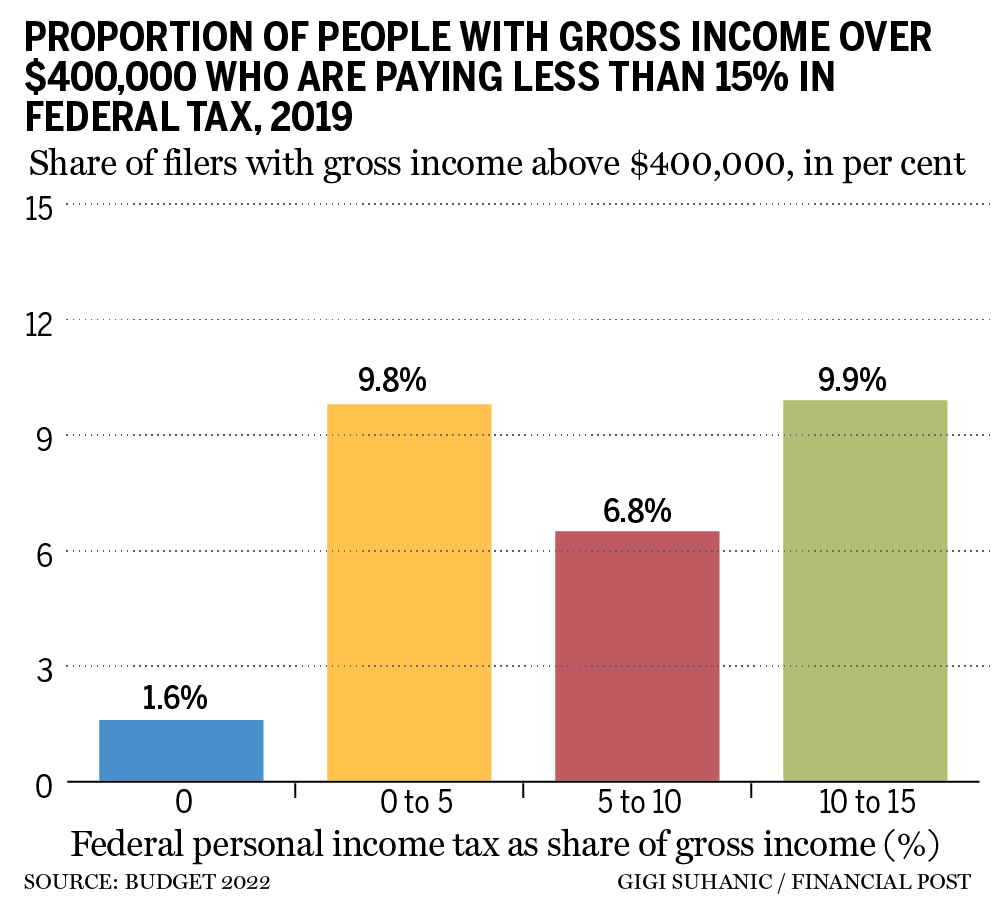
The finances doc offered some stats, utilizing 2019 tax knowledge, that confirmed 28 per cent of filers with gross earnings of greater than $400,000 (which was the highest 0.5 per cent of all earnings earners), or about 41,400 people, paid a mean federal tax fee of 15 per cent or much less by utilizing a wide range of tax deductions and tax credit. Extra granularly, the info present that almost 18 per cent of these high earnings earners (about 27,000 Canadians) paid lower than 10 per cent in federal tax. And apparently 1.6 per cent (2,400 filers) paid zero federal tax.
The info was revealed as a manner of introducing the federal government’s overview of the choice minimal tax (AMT), the outcomes of which can come out within the fall financial replace. However are these numbers truly a priority? Is there something nefarious about such a low efficient fee? Or are taxpayers merely following the legislation in accordance with the well-accepted Duke of Westminster precept that states “taxpayers are entitled to rearrange their affairs to reduce the quantity of tax payable.” Based mostly on a 1936 tax case in the UK, this precept was confirmed most just lately by Canada’s Supreme Court docket in a November 2021 determination.
Commercial 3
Article content material
It’s a query price exploring. To start, bear in mind the finances stats solely appeared on the federal tax fee and never the mixed federal/provincial fee. Presently, there are 5 federal earnings tax brackets for 2022: zero to $50,197 of earnings (15 per cent); greater than $50,197 to $100,392 (20.5 per cent); above $100,392 to $155,625 (26 per cent); over $155,625 to $221,708 (29 per cent); and something above $221,708 is taxed at 33 per cent.
As a result of graduated, progressive charges on the primary $221,708, the federal tax for 2022 on $400,000 of extraordinary earnings could be about $109,000 for a mean federal tax fee of about 27 per cent, earlier than contemplating tax-preferred earnings and numerous different deductions and credit.
Commercial 4
Article content material
Capital features are solely 50-per-cent taxable, which means that a person who realizes a one-time achieve on the sale of their cottage of, say, $400,000, would have gross earnings of $400,000, however taxable earnings of $200,000, as a result of solely half the achieve is taxable. Absent some other earnings, the federal tax invoice could be about $43,000 and the common federal tax fee could be 10.8 per cent on capital features. However is the cottage vendor, who had one yr of very elevated earnings, actually a “high-income” earner on which the federal government must cost an AMT?
A fast have a look at the 2019 Canada Income Company earnings statistics for the 2017 tax yr (the newest publicly accessible knowledge) exhibits that 51 per cent of the returns by the best earnings earners (outlined for these statistics as these making greater than $250,000), about 312,000 Canadians, reported a taxable capital achieve, with the common being simply over $125,000, which might possible point out the common capital achieve was about $250,000.
Commercial 5
Article content material
Subsequent, let’s take into account an investor who earns $400,000 in Canadian-eligible dividends. Due to the dividend tax credit score, equal to twenty.73 per cent of the particular dividends obtained, the federal tax on $400,000 of eligible dividends would solely be $76,000 for a mean federal tax fee of 18.9 per cent, which may additionally decrease the common tax fee from the anticipated fee. Two-thirds of the best earnings earners in 2017 reported some Canadian dividends, with the common quantity being greater than $100,000.
After all, tax deductions may scale back your common tax fee. The highest three deductions (by whole greenback worth) claimed in 2017 by the best earnings earners, had been the registered retirement financial savings plan (RRSP) deduction, lifetime capital features exemption (LCGE) and the worker stock-option deduction.
Commercial 6
Article content material
Canada Income Company knowledge for 2017 exhibits 60 per cent of high earnings earners claimed an RRSP deduction (common declare of $38,730, which means some taxpayers had been clearly catching up on unused RRSP contribution room). And whereas the stock-option deduction for workers was taken by solely 4 per cent of the best earnings earners, the common deduction was virtually $152,000. (This may possible begin to go down in future years for the reason that guidelines limiting the advantages of the stock-option deduction had been modified as of July 1, 2021).
-

Jamie Golombek: Right here’s how the federal finances impacts your pockets
-

Jamie Golombek: What tax adjustments may be arising within the federal finances
-

Higher double-check your tax return if you happen to’ve been utilizing the CRA’s Auto-fill
-

You’ve obtained questions in regards to the CRA’s principal residence exemption, we’ve obtained solutions
Commercial 7
Article content material
In 2022, the LCGE eliminates taxes on $913,630 of capital features from the sale of qualifying small-business shares, and $1 million of capital features on the sale of certified farming or fishing property. The CRA knowledge present that almost 18,000 of the best earnings taxpayers in 2017 claimed LCGE deductions valued at $4.6 billion, with the common declare coming to about $260,000, which is the equal of $520,000 of tax-free capital features. This may possible clarify the zero tax fee for some taxpayers within the 2022 finances doc.
Lastly, on the credit score aspect, are charitable donations. A high-income earner who makes a big donation of, say, $100,000 to charity, could be entitled to a federal donation tax credit score of 33 per cent. The tax payable on $400,000 after contemplating the donation tax credit score for a $100,000 donation could be about $75,000 for a mean federal tax fee of 18.9 per cent. The CRA knowledge present that 64 per cent of the best earnings earners in 2017 reported a charitable present, with the common present being $17,389. Charitable items, relying on the quantum, can considerably scale back your common tax fee.
Commercial 8
Article content material
We have already got a federal AMT at a 15-per-cent fee. If the federal government needs to protect the complete advantages of charitable giving, preserve integration intact by permitting the dividend tax credit score designed to reduce the double taxation of company earnings, and preserve the decrease capital features inclusion fee or the LCGE on the one-time sale of a cottage, enterprise or farming or fishing property, there’s little tax income left to reap in an up to date AMT, significantly given the adjustments already launched final yr on worker inventory choices.
Jamie Golombek, CPA, CA, CFP, CLU, TEP is the managing director, Tax & Property Planning with CIBC Personal Wealth in Toronto. Jamie.Golombek@cibc.com
_____________________________________________________________
For extra tales like this one, join for the FP Investor publication.
______________________________________________________________
Commercial

[ad_2]








Leave a Reply