
[ad_1]
It’s simple to be in denial about debt. However when nervousness and worry take over, it may well have an effect on extra than simply your monetary life. In case you really feel paralyzed by crushing debt, know that there’s a manner out: chapter.
Whether or not you go for Chapter 7 or Chapter 13 chapter, it received’t be a straightforward street. However it may well assist you regain management of your life and get again on stable monetary footing.
The way it works depends upon which one you select. And which will rely in your particular person circumstances. So it pays to grasp the ins and outs of each earlier than deciding which one’s best for you.
Chapter 7 vs. Chapter 13 Chapter
Earlier than you file chapter, it’s very important to grasp that some money owed are handled in a different way in chapter. Precedence money owed will stick round afterward, whether or not you select Chapter 7 or Chapter 13. In case you owe little one help or alimony or have tax debt or federal scholar loans, you possibly can’t use chapter to remove them.

Motley Idiot Inventory Advisor suggestions have an common return of 618%. For $79 (or simply $1.52 per week), be part of greater than 1 million members and do not miss their upcoming inventory picks. 30 day money-back assure. Signal Up Now
Chapter additionally won’t remove any secured money owed you may have. Secured money owed are something that’s backed by collateral, often the factor you’re shopping for with the mortgage, corresponding to your mortgage funds or automotive loans.
That doesn’t imply it’s a must to give up your house or automotive whenever you file chapter. As an alternative, you possibly can proceed making funds on these money owed, although how that occurs depends upon which kind of chapter you select. In case you nonetheless owe on them, you proceed to pay your secured loans after the chapter is over too.
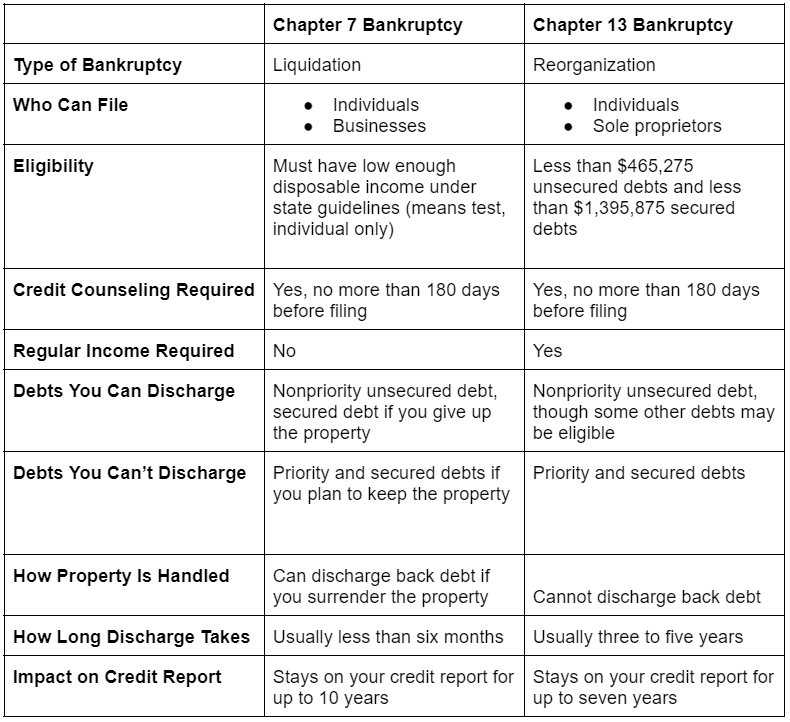
In each instances, whenever you file for chapter, the court docket points an computerized keep, which prevents your collectors or assortment businesses from making an attempt to gather your money owed. Each kinds of chapter may help you retain sure kinds of property and offer you a little bit of respiration room. Each additionally require credit score counseling not more than 180 days earlier than submitting.
However there are some essential variations between Chapter 7 and 13 chapter.
Chapter 7 Chapter – The Fast and Simple Choice
Chapter 7 is usually the faster and simpler possibility, because it’s often over inside a number of months and completely discharges any qualifying debt. It’s a liquidation chapter, which means the trustee may promote (liquidate) your belongings to pay down your money owed. In case you solely have unsecured, nonpriority money owed and don’t have a number of belongings, Chapter 7 is often the higher possibility.
Throughout Chapter 7, the chapter trustee, a person the court docket assigns to symbolize your property in chapter, can promote your belongings, whether or not they’re high-value gadgets like a ship or bike or lower-value gadgets like furnishings or designer clothes.
Chapter 7 does have earnings limits, so that you won’t qualify in case you earn an excessive amount of or in case your debt-to-income ratio, the quantity of debt you owe versus how a lot you make expressed as a proportion of how a lot of your earnings goes towards money owed, isn’t excessive sufficient. That along with your loved ones dimension is what the federal government calls a “means check.”
Money owed you possibly can discharge in Chapter 7 chapter embody:
- Bank card debt
- Medical debt
- Previous-due hire
- Private loans
- Previous-due federal and state earnings taxes (not less than three years outdated)
- Previous-due utility payments
- Previous-due lawyer’s charges
- Civil court docket judgments
Secured money owed, that are backed by property, corresponding to a automotive or home, get handled in a different way in Chapter 7. You possibly can discharge any again debt on them, supplied you hand over the collateral. If you wish to preserve the property related to secured money owed, you could reaffirm the debt and proceed making funds. You should be up-to-date on funds to take action.
In case you’re behind on secured money owed, there’s a danger of shedding the collateral (corresponding to your house). Even in case you don’t discharge it, the trustee can promote it if there’s sufficient fairness constructed up.
However you may qualify for an exemption, relying on the property kind. An exemption protects your property from collectors. However in case you owe quite a bit, the exemption won’t be sufficient to completely shield you.
There are a number of benefits to Chapter 7 chapter.
- You possibly can wipe out unsecured money owed (and doubtlessly secured money owed), providing you with a contemporary begin.
- It occurs rapidly, in as little as a number of months.
- It will get collectors and assortment businesses off your again.
However there are some important disadvantages it is best to think about:
- The chapter trustee can promote sure possessions.
- You’re on the danger of a foreclosures on your house or repossession of your automotive, because it doesn’t provide the choice to catch up in case you’ve fallen behind on funds.
- The chapter can keep in your credit score report for a decade.
- Your credit score rating will drop, although it will not be that a lot and is likely to be preferable to debt.
Chapter 13 Chapter – Debt Reorganization and Cost Plan
In case you don’t qualify for Chapter 7, Chapter 13 is the way in which to go. In contrast to Chapter 7, Chapter 13 requires you to repay your money owed by a fee plan created by the chapter trustee. Chapter 13 is a reorganization chapter because the fee plan rearranges your money owed.
Observe that there’s a restrict to how a lot debt you possibly can should qualify for Chapter 13. You should have lower than $465,275 in unsecured money owed and fewer than $1,395,875 in secured money owed.
The trustee will rank your money owed beneath the fee plan to make sure precedence money owed (corresponding to alimony) receives a commission in full by the point the plan is full (in three to 5 years). The plan will even account for secured money owed you may have and, in case you can afford to pay them, unsecured money owed. The quantity you pay beneath the fee plan relies in your month-to-month earnings.
Chapter 13 takes longer than Chapter 7, in some instances as much as 5 years. How lengthy depends upon the compensation plan. In case your earnings is under the state’s median month-to-month earnings, your plan lasts three years. In case you earn greater than the state median earnings, it lasts 5 years.
Chapter 13 chapter allows you to discharge a number of extra money owed than Chapter 7. The extra debt varieties you possibly can discharge in Chapter 13 embody:
- Money owed for malicious and willful harm to property (however to not an individual)
- Money owed to pay for nondischargeable tax obligations
- Money owed related to property settlements in a divorce or separation (aside from help obligations like alimony and little one help)
- Excellent money owed from a earlier chapter during which the court docket denied your discharge
- Retirement account loans
- Any householders affiliation or condominium charges due after your submitting date
- Sure noncriminal authorities fines and penalties
It’s essential to proceed making funds on secured money owed if you wish to preserve the property related to them. The good thing about Chapter 13 is that it means that you can reschedule the debt and doubtlessly cut back the worth of some property varieties, corresponding to a automotive.
With Chapter 13, you possibly can proceed to make funds on secured money owed as soon as the fee plan is full. You don’t should pay them in full inside three to 5 years.
Whereas Chapter 13 doesn’t fully erase your debt, there are a number of causes folks usually view it extra favorably than Chapter 7.
- It creates a fee plan to make your debt extra manageable.
- It impacts your credit score rating lower than Chapter 7.
- You possibly can preserve your own home and different belongings so long as you pay the money owed related to them.
- It will get collectors and assortment businesses off of your again.
However there are nonetheless some important disadvantages.
- The method takes for much longer than Chapter 7.
- You might need issue making funds beneath your fee plan except you make and follow a funds.
- The chapter will keep in your credit score report for seven years.
- Your credit score rating will drop, although it will not be that a lot and it might be preferable to staying in debt.
Which Is Proper for You: Chapter 7 or Chapter 13 Chapter?
Whether or not it’s finest to file Chapter 7 or 13 largely depends upon your earnings and what kinds of debt you may have.
You Ought to File Chapter 7 Chapter If…
Total, Chapter 7 chapter is finest for lower-income Individuals who’re in manner over their heads. Chapter 7 chapter is a greater match if:
- Your Earnings Is Beneath the Median in Your State. You should go a way check to be eligible for Chapter 7. You mechanically go the check in case you earn lower than the median month-to-month earnings in your state.
- You Don’t Have a Lot of Belongings. Your chapter trustee can promote your stuff to repay collectors throughout Chapter 7. Whereas there are exemptions, it’s often higher for a debtor to not have a number of belongings or possessions once they file for Chapter 7 chapter.
- You Primarily Have Unsecured Money owed. In case you owe again taxes, alimony, little one help, or scholar loans, chapter received’t assist. You’re nonetheless on the hook when you’ve got secured money owed and need to preserve the collateral. Chapter 7 isn’t a magical get-out-of-debt-free go. However when you’ve got bank card debt, medical payments, or unsecured private loans, Chapter 7 can provide you a contemporary begin.
- You Don’t Have Sufficient Disposable Earnings to Repay Your Money owed. You possibly can go the means check even when your earnings is above the state median, supplied your disposable earnings (what’s left over after you pay for all of your essential bills) isn’t sufficient to cowl your month-to-month debt funds.
You Ought to File Chapter 13 Chapter If…
When you have ample earnings however nonetheless wrestle to make your funds, Chapter 13 is likely to be a greater match. Chapter 13 chapter is a greater match if:
- Your Earnings Is Above the State Median. To qualify for Chapter 13, you must have a daily earnings. In case you don’t go the means check for Chapter 7, Chapter 13 is likely to be your higher possibility.
- You Personal Your Dwelling or Automotive. Submitting Chapter 13 can preserve your house out of foreclosures, as you may have the choice of catching up in your mortgage funds. You may also make amends for different kinds of secured debt, corresponding to your automotive mortgage.
- You Don’t Have Too A lot Debt. Chapter 13 has an unsecured debt restrict of $465,275
and a restrict of $1,395,875 for secured debt. In case you owe extra, Chapter 11, which is often reserved for companies, is likely to be the higher alternative for you.
- You Can Afford the Month-to-month Cost. To get a discharge from Chapter 13, which means you’re freed from all of your unsecured money owed, you must full your fee plan. Meaning you want to have the ability to afford the month-to-month fee. In case you imagine your earnings will stay regular sooner or later, you possibly can really feel fairly good about submitting Chapter 13.
Remaining Phrase
Whether or not you find yourself submitting for Chapter 7 or Chapter 13, chapter isn’t one thing to hurry into. The chapter courts appear to acknowledge that, as all filers want to finish a credit score counseling course throughout which they study their debt compensation choices and punctiliously consider whether or not chapter is your best option earlier than they file.
However make sure you communicate with a chapter lawyer to get a greater sense of what your chapter choices are first. It’s very tough to efficiently file chapter with out one.
Talking with a fiduciary monetary advisor may also assist you resolve if Chapter 7 or 13 will present the aid you want or if one other debt aid possibility, corresponding to negotiating along with your lenders or getting on a debt administration plan, is the best alternative.
[ad_2]








Leave a Reply