
This was surprising to hear.
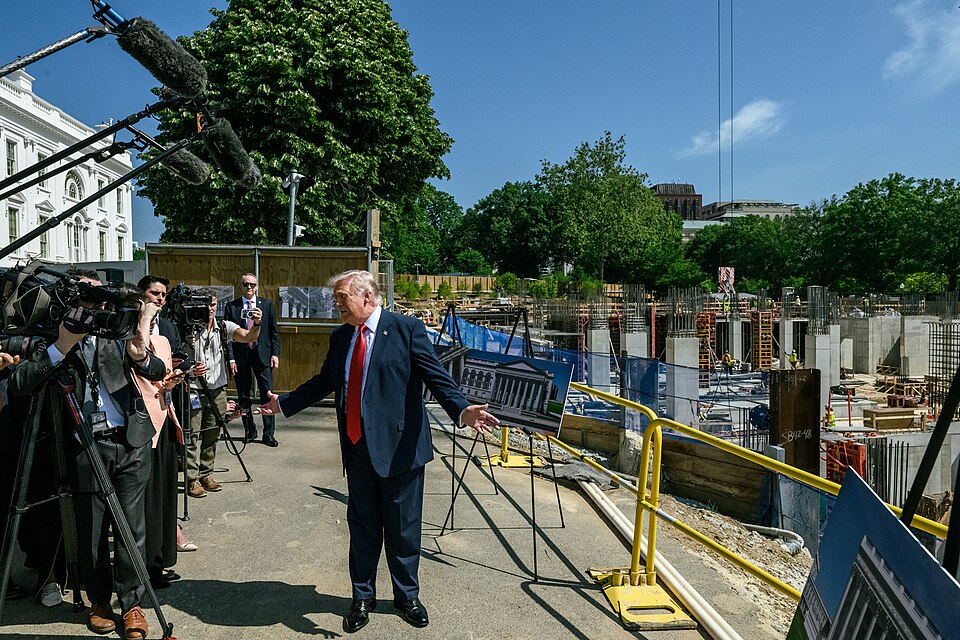
President Donald Trump has revealed an unusual new detail about his massive White House ballroom project, claiming the structure is being built with extraordinarily strong steel and concrete designed to withstand extreme conditions.
Trump says the building will be so difficult to demolish that a future administration could struggle to remove it even if it wanted to.
At the center of his claim is a material the president calls “nuclear concrete.”
The description immediately raises an obvious question: What exactly is being used to build Trump’s new White House ballroom?
Trump Says Ballroom Will Be Extremely Difficult to Demolish
Trump discussed the construction project during a wide-ranging interview published Friday.
Asked about the possibility that a future Democratic administration could tear down the ballroom, Trump argued that doing so would be physically difficult because of the way the structure is being built.
The president said crews are using exceptionally strong welded steel along with concrete comparable to material used in nuclear power facilities.
Trump described it as “nuclear concrete” and claimed even prolonged use of a jackhammer against some of the building’s columns might barely leave a mark.
The phrase is Trump’s description of the material rather than the conventional name of a specific type of concrete.
His larger point was clear: Trump wants the new addition to the White House to be built to last.
White House Ballroom Is Part of a Much Larger Project
The ballroom is more than a large room for presidential dinners and official ceremonies.
Construction involves replacing the former East Wing with an expansive new complex that includes the above-ground ballroom and a below-ground military installation.
Plans for the development have also included major entertainment, kitchen and security facilities.
The scale of the project has made it one of the most closely watched White House renovations in modern history.
Trump, who spent decades in real estate and construction before entering politics, has taken an unusually personal interest in the development.
Supreme Court Allows Construction to Continue
The ballroom has also become the subject of a significant legal fight over presidential power and federal property.
On Aug. 31, the Supreme Court allowed construction to continue while litigation over the project moves forward.
The case was brought by the National Trust for Historic Preservation, which challenged aspects of the project and previously secured a lower-court injunction affecting construction.
The Supreme Court’s decision did not settle every underlying legal question surrounding the ballroom. Instead, it allowed work to proceed while the broader dispute continues through the courts.
That means construction crews can keep working on Trump’s ambitious addition to the White House despite the ongoing legal battle.
$400 Million Ballroom Sparks Debate in Washington
The project’s enormous price tag has generated almost as much attention as its architecture.
The ballroom undertaking has been widely described as costing hundreds of millions of dollars, with private donations playing an important role in financing the project.
Trump has promoted private funding as a major advantage, arguing that wealthy supporters and other donors can help finance improvements rather than leaving taxpayers responsible for the entire bill.
Critics have raised questions about the project’s cost, financing and the identities of major donors.
Democratic lawmakers have also signaled interest in examining the funding arrangements, particularly donations involving companies or individuals that conduct business with the federal government.
Those concerns do not by themselves establish that donors received government favors in exchange for contributions.
Nevertheless, the financing controversy could keep the ballroom in the political spotlight long after construction is finished.
Democrats Target Trump’s Ballroom
Democrats have increasingly used the ballroom to criticize Trump’s priorities.
Their argument is that an enormous White House construction project creates unfavorable optics while millions of Americans remain concerned about inflation, housing expenses, groceries, energy costs and other household bills.
Public polling has also indicated significant opposition to Trump’s construction plans in Washington.
At the same time, some Democrats have questioned whether concentrating too heavily on the ballroom could distract their party from economic issues that directly affect voters.
Former Obama administration spokesman Tommy Vietor, for example, suggested Democrats have more important matters to focus on than the building.
That disagreement highlights a larger political question surrounding the controversy: Will Americans ultimately care about the ballroom itself, or will issues such as jobs, inflation, retirement security and the cost of living matter considerably more?
Trump Keeps Close Eye on Construction
Trump’s involvement reportedly goes well beyond approving blueprints.
The president has been closely monitoring construction and can reportedly observe the work from the White House residence.
His son Eric Trump has described his father’s enthusiasm for the development, saying Trump sometimes checks on the construction late in the evening.
For someone who built his reputation in New York real estate, the fascination is hardly surprising.
Long before Trump became president, his name was associated with hotels, resorts, skyscrapers and other large construction projects.
Now he has an opportunity to oversee a project at America’s most famous residence.
Trump Wants to Leave His Mark on Washington
The White House ballroom is only one component of Trump’s broader effort to change the physical appearance of Washington.
Since beginning his second term in January 2025, Trump has pursued a series of renovations and construction projects involving prominent federal properties and landmarks.
Those efforts have included changes around the White House grounds and proposals involving some of Washington’s most recognizable locations.
Supporters and critics see those projects very differently.
Supporters can point to Trump’s background as a builder and his desire to improve federal properties and create permanent spaces for official functions.
Critics question the projects’ cost, appearance and the extent of presidential authority over historically important government property.
Either way, Trump clearly considers architecture part of his presidential legacy.
Will It Eventually Be Called the Trump Ballroom?
One question may remain long after the concrete dries: What will the ballroom eventually be called?
Trump was asked whether he believes the building should carry his name.
He said he believes it should, although no final decision has been made.
For now, however, Trump appears more focused on getting the massive project completed.
And judging by his description of the welded steel and unusually strong concrete supporting it, the president isn’t building something he expects Washington to replace anytime soon.
Whatever future presidents think about the ballroom, Trump is making one thing clear: He intends his newest addition to the White House to stand for generations.








Leave a Reply