
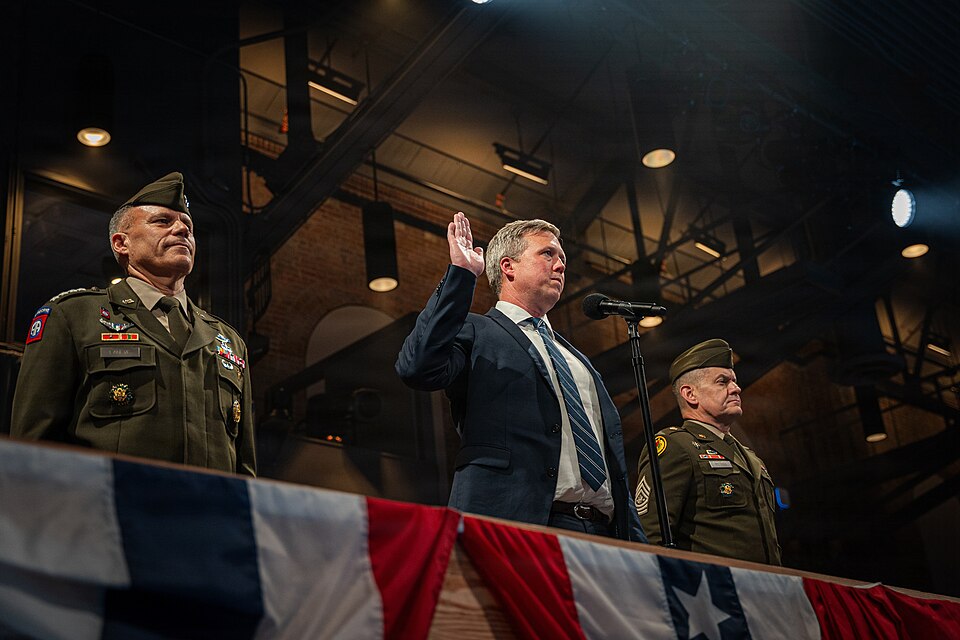
Here’s what was said.
A top United States Army general has issued a serious warning about America’s national security, revealing that the next major war involving the United States could bring dangerous threats directly onto American soil.
The warning comes as President Donald Trump’s administration faces growing concerns about China’s military expansion, sophisticated cyberattacks, and rapidly advancing drone technology that could threaten American military bases and critical infrastructure.
General Christopher LaNeve, currently serving as the Army’s acting chief of staff, warned that the United States can no longer assume future military conflicts will remain safely overseas.
His remarks highlight a troubling possibility: American military installations, transportation networks, and essential communications systems could become targets during a major international confrontation.
For the Trump administration, the warning underscores the importance of strengthening homeland defense while maintaining America’s military superiority.
Army General Warns Future Wars Could Threaten American Soil
Speaking during the Association of the United States Army’s annual conference in Washington, D.C., LaNeve explained that the military must reconsider assumptions that shaped American defense planning for decades.
During the wars in Iraq and Afghanistan, American troops generally benefited from secure bases and reliable transportation networks while preparing for overseas deployments.
Those advantages allowed the military to concentrate its resources on fighting adversaries far from American communities.
However, LaNeve believes a future conflict involving a technologically advanced rival could unfold differently.
An enemy could attempt to disrupt American military operations before troops even reach the battlefield.
That could include interference with transportation systems, communications networks, and installations responsible for deploying soldiers and military equipment.
The general’s central concern is that the United States must prepare to defend its military capabilities at home, not simply defeat adversaries abroad.
This represents a significant shift in how military commanders are preparing for potential future conflicts.
China Raises Serious Concerns for America’s Military
China remains one of the most significant challenges facing American defense planners.
Beijing has spent years expanding its military capabilities, including investments in advanced weapons, cyberwarfare, surveillance systems, and technologies designed to challenge American military operations.
According to Pentagon assessments, Chinese cyber capabilities have been positioned within portions of America’s critical infrastructure networks.
Military officials are concerned that those capabilities could potentially be used to interfere with American military mobilization during a future conflict.
For example, disruptions affecting transportation networks or communications systems could make it more difficult for the United States to move troops and equipment overseas.
Such interference would not necessarily require a conventional military invasion.
Instead, an adversary could attempt to weaken America’s ability to respond through coordinated technological operations.
These concerns are particularly important because the United States depends on extensive logistical networks to maintain its global military presence.
Protecting those networks could become just as important as protecting military ships, aircraft, and ground forces.
Although officials have not announced that a direct conflict with China is imminent, military leaders are preparing for scenarios involving threats that previous generations of commanders rarely encountered.
Drone Activity Near U.S. Military Bases Raises New Questions
Another major concern involves the growing availability and effectiveness of unmanned aircraft.
Drones have fundamentally changed modern warfare by allowing militaries to conduct surveillance, gather intelligence, and carry out attacks using relatively inexpensive equipment.
American officials have already reported unauthorized drone activity near sensitive military installations.
Among the locations previously affected are Joint Base Langley-Eustis in Virginia and Picatinny Arsenal in New Jersey.
Authorities have not publicly attributed those incidents to China.
Nevertheless, the events have intensified discussions about the country’s ability to detect and counter unauthorized aircraft operating near sensitive facilities.
Military bases were traditionally designed to withstand conventional security threats.
However, smaller drones introduce challenges that may require additional defensive systems, updated procedures, and specialized training.
Some unmanned aircraft can operate at low altitudes, making them difficult to identify using traditional surveillance equipment.
For American military commanders, these developments raise an increasingly important question: How can the country protect essential defense installations against technologies that are becoming more accessible and sophisticated?
The Army is now working with other federal agencies and law enforcement organizations to address those concerns.
Trump’s Pentagon Moves to Strengthen Military Readiness
As the national security environment changes, Army officials are introducing updated strategies to help American troops prepare for modern combat.
A new operational framework called How the Army Fights places greater emphasis on maintaining military effectiveness even when important support systems are disrupted.
The approach recognizes that future adversaries may attempt to interfere with communications, logistical networks, and military installations.
Instead of assuming that every system will remain operational, commanders are being encouraged to prepare their soldiers to function under more difficult circumstances.
LaNeve has emphasized the importance of military units being able to continue their missions even when communications equipment becomes temporarily unavailable.
That could require soldiers to rely more heavily on traditional battlefield skills, independent decision-making, and flexible operational planning.
The goal is to ensure American forces remain capable of fighting effectively even when an opponent attempts to undermine their technological advantages.
The strategy also reflects lessons emerging from modern conflicts, where drones and electronic warfare have demonstrated how quickly battlefield conditions can change.
For President Trump, these developments reinforce the importance of maintaining a military capable of responding to both conventional and emerging threats.
Southern Border Provides Real-World Military Training
The United States military is also gaining practical experience with drone threats along the southern border.
Acting Army Secretary Adam Telle has highlighted how soldiers supporting border operations are testing technologies intended to detect and counter unmanned aircraft.
The experience provides opportunities to evaluate equipment in situations where drones may be used for surveillance and other activities.
Military officials believe the knowledge gained from those operations could prove valuable when preparing forces for future missions.
Meanwhile, Joint Interagency Task Force 401 is coordinating with federal and local law enforcement agencies to strengthen defenses around military installations and critical infrastructure.
These efforts demonstrate how national defense responsibilities increasingly involve cooperation between the armed forces and domestic security organizations.
Border security and military readiness are separate responsibilities, but certain technological challenges overlap.
The growing use of drones is one example of how lessons learned during domestic operations may help improve the military’s broader defensive capabilities.
Air Force Officials Deliver Another Warning
The Army is not the only military branch expressing concerns about the changing nature of warfare.
Air Force Secretary Troy Meink has warned that advances in surveillance technology could make it increasingly difficult for military forces to operate without being detected.
As sensors, artificial intelligence, and sophisticated monitoring systems improve, adversaries may gain greater opportunities to track military movements.
Meink suggested that dramatic advances in these capabilities could emerge within the next five years, potentially sooner.
Such developments could complicate military operations by making it more difficult for aircraft, vehicles, and other assets to avoid detection.
In response, the Pentagon is exploring additional technologies designed to improve the survivability of American forces.
These include autonomous systems capable of conducting missions in dangerous environments.
The broader objective is to preserve America’s ability to respond effectively even when potential adversaries possess advanced surveillance and targeting capabilities.
Pentagon Leadership Criticizes Previous Military Priorities
The warnings also come amid broader disagreements over how quickly the United States has adapted to emerging defense technologies.
War Secretary Pete Hegseth has criticized the Pentagon’s approach under the Biden administration, arguing that military leadership previously failed to move quickly enough in several important technological areas.
His criticism has focused on developments involving drones, hypersonic weapons, and space-based military capabilities.
Those remarks reflect the Trump administration’s emphasis on accelerating military modernization and preparing American forces for future challenges.
However, strengthening military readiness involves more than purchasing advanced equipment.
It also requires developing effective operational strategies, training personnel, and ensuring that sophisticated weapons systems remain useful under difficult battlefield conditions.
Military officials have emphasized that technology should support soldiers rather than replace their fundamental skills.
That distinction is becoming increasingly important as potential adversaries develop systems designed to interfere with America’s technological advantages.
What Does This Warning Mean for President Trump?
LaNeve’s comments present an important national security challenge for the Trump administration.
The United States must remain prepared to respond to threats overseas while also protecting installations and infrastructure located within its own borders.
Maintaining that balance could become more difficult as cyberwarfare, unmanned systems, and advanced surveillance technologies continue evolving.
The general’s warning does not mean that American communities are facing an immediate military attack.
Instead, it reflects the Pentagon’s growing recognition that future adversaries may attempt to disrupt American military operations much closer to home.
That possibility creates several important priorities for military leaders, including improving defenses at military installations, strengthening critical infrastructure protection, and ensuring that soldiers can function when advanced systems fail.
For Trump, decisions involving military modernization and homeland defense could have lasting consequences for America’s national security.
The administration must weigh emerging technological threats while maintaining the conventional military capabilities that have supported American defense for generations.
America’s National Security Faces a New Test
America’s armed forces remain among the most capable and technologically advanced in the world.
However, senior military leaders increasingly recognize that the nature of future warfare could challenge longstanding assumptions about the country’s security.
Cyber operations, advanced drones, and sophisticated surveillance capabilities could allow adversaries to threaten important military systems without relying on traditional methods of attack.
These concerns explain why the Army is placing renewed emphasis on homeland defense, military readiness, and the ability to operate under disrupted conditions.
The warning from General LaNeve ultimately highlights a critical reality: America’s military must prepare for a future in which protecting the homeland is an essential part of fighting conflicts overseas.
For President Trump and his national security team, the challenge will be ensuring that American forces remain prepared for threats that continue to change.
No imminent attack was announced, but the message from military leadership is clear.
The next major conflict could test America’s defenses in ways the country has not experienced during recent decades.
And ensuring that the United States is prepared for those possibilities could become one of the most important national security responsibilities facing the Trump administration.




Leave a Reply