
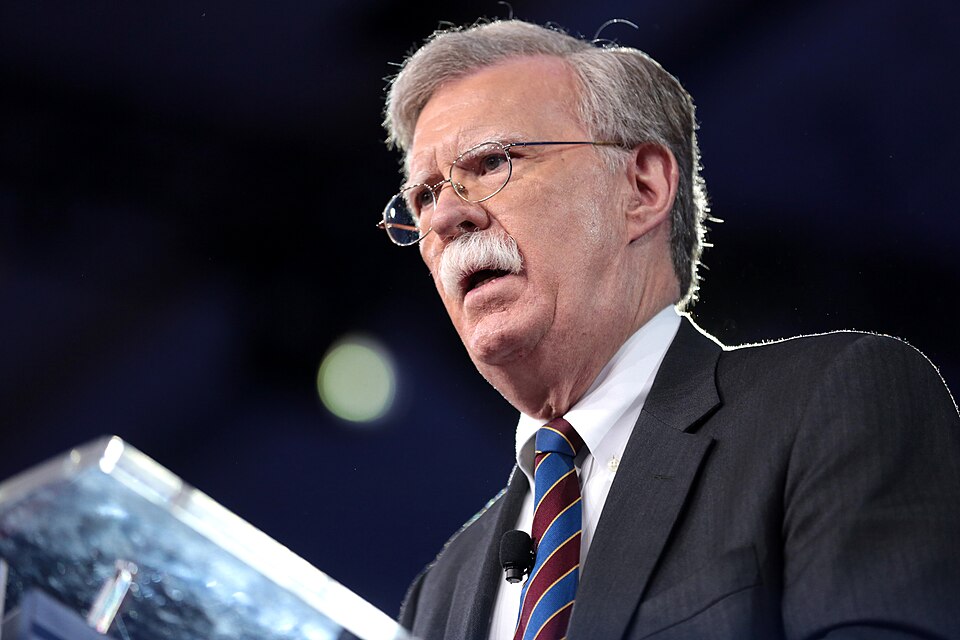
Bolton is losing it.
Former White House national security adviser John Bolton unleashed another blistering attack on President Donald Trump Tuesday, accusing his former boss of being “lost at sea” as the administration confronts major foreign-policy challenges involving Iran, North Korea and America’s allies.
Bolton, who served in Trump’s first administration before becoming one of the president’s most outspoken critics, argued that Trump’s unconventional approach to diplomacy is putting important American relationships at risk.
His comments came during an appearance on MS NOW, where Bolton criticized both Trump’s recent rhetoric toward Oman and the president’s decision to scale back U.S. military exercises with South Korea.
The remarks mark another chapter in the bitter falling-out between Trump and a former senior official who once helped shape national-security policy inside his White House.
Bolton Launches Harsh Attack on Trump
During the interview, host Peter Alexander asked Bolton about Trump’s recent threat against Oman, a longtime American partner that has played a significant diplomatic role in negotiations involving Iran.
Bolton acknowledged that Oman has maintained close relations with Iran and raised his own questions about whether the country should serve as a mediator in certain negotiations.
But he quickly turned his attention toward Trump.
Bolton argued that the president should show greater restraint when speaking publicly about sensitive international matters. He then claimed Trump’s rhetoric was evidence that the commander in chief was “lost at sea” and “floundering.”
According to Bolton, Trump “doesn’t know what to do.”
Those are extraordinary words coming from someone who previously served as Trump’s national security adviser and had direct access to some of the most sensitive foreign-policy discussions in the federal government.
They also demonstrate just how dramatically the relationship between the two men has changed.
Trump Supporters See a Very Different Strategy
Bolton’s assessment is hardly the only way to view Trump’s approach.
Supporters of the president have long argued that Trump’s willingness to speak unpredictably is part of his negotiating strategy.
Unlike many traditional politicians, Trump has repeatedly demonstrated a willingness to use tough rhetoric against foreign governments while simultaneously leaving the door open for direct negotiations.
His supporters believe that unpredictability can give the United States leverage because adversaries cannot automatically assume how Washington will respond.
Critics, including Bolton, argue that the same approach can create uncertainty among America’s allies.
That disagreement has followed Trump throughout both of his presidential administrations and remains at the center of the debate over his foreign policy.
North Korea Sparks Another Dispute
Bolton also targeted Trump’s handling of North Korea.
Trump recently ordered the Pentagon to substantially reduce planned joint military exercises with South Korea. The president has emphasized his positive relationship with North Korean leader Kim Jong-un and described North Korea as “unthreatening” and “respectful” during his current administration.
Bolton strongly disagrees with the decision.
The former national security adviser pointed back to Trump’s historic 2018 summit with Kim in Singapore, when the president announced that major military exercises involving the United States and South Korea would be suspended.
Bolton described that earlier move as an unnecessary concession.
He now argues that reducing exercises again could send the wrong message to America’s adversaries.
“It was a mistake,” Bolton said of the earlier decision, arguing that making a similar move today would be an even greater error.
Trump Has Long Questioned Costly Military Commitments
Trump’s position, however, reflects a much broader argument he has made for years.
The president has repeatedly questioned whether America’s allies contribute enough toward their own defense and whether U.S. taxpayers should continue carrying a disproportionate share of certain international security costs.
That philosophy has frequently put Trump at odds with Washington’s traditional foreign-policy establishment.
For decades, Republican and Democratic administrations generally supported extensive American military commitments overseas as an important tool for deterring adversaries and protecting U.S. interests.
Trump has challenged parts of that consensus.
He has pushed allies to spend more on defense, questioned the cost of overseas military operations and emphasized direct negotiations with foreign leaders when he believes diplomacy could produce results.
For many conservative voters, those arguments fit into Trump’s broader America First philosophy.
For Bolton, however, reducing military exercises risks weakening deterrence.
Bolton Warns America’s Enemies Are Watching
Bolton went further, suggesting that the consequences could extend well beyond the Korean Peninsula.
He argued that Iran and other governments would closely watch America’s treatment of South Korea and could interpret reductions in military exercises as evidence that Washington is becoming less determined.
Whether America’s adversaries actually reach that conclusion remains a matter of debate.
Supporters of Trump’s approach could argue the opposite: that a president willing to combine military strength, economic pressure and direct diplomacy may be harder for adversaries to predict.
That disagreement gets to the heart of the Trump-Bolton feud.
Bolton has traditionally supported a more aggressive and conventional approach to projecting American power abroad. Trump has often been more skeptical of prolonged overseas commitments while remaining willing to threaten overwhelming force when he believes American interests are endangered.
Bolton Targets Trump’s Personal Diplomacy
Bolton also criticized Trump’s tendency to place considerable importance on his personal relationships with foreign leaders.
Trump has repeatedly spoken about his ability to communicate with powerful figures including Kim, Chinese President Xi Jinping and Russian President Vladimir Putin.
The president has argued throughout his political career that maintaining communication with America’s rivals can be preferable to refusing to engage with them.
Bolton sees things differently.
He argued that having a productive personal relationship with another country’s leader does not necessarily mean the United States has a strong relationship with that country.
Bolton pointed to Trump’s relationship with Kim as an example.
During Trump’s first administration, the president famously described the unusual relationship between the two leaders by saying they “fell in love” following an exchange of letters.
For Bolton, that style of personal diplomacy is a weakness.
For Trump’s supporters, however, the willingness of an American president to personally engage an adversary can be viewed as another diplomatic tool — particularly when the alternative could involve escalating military tensions.
From Trump Adviser to Trump Critic
Bolton’s latest criticism carries additional weight because he once worked inside Trump’s White House.
Trump selected Bolton to become national security adviser in 2018.
But the two men had significant disagreements over foreign policy, and Bolton departed the administration the following year.
Their relationship subsequently deteriorated.
Since leaving the White House, Bolton has repeatedly criticized Trump’s judgment, leadership and approach to international affairs. Trump, in turn, has repeatedly attacked Bolton and rejected his assessment of the administration.
The dispute is therefore about more than one military exercise or one controversial presidential statement.
It represents two competing visions for America’s role in the world.
Two Very Different Visions for American Power
Bolton represents a more traditional hawkish school of foreign policy that generally favors maintaining a powerful American military presence around the world and taking an uncompromising position toward hostile governments.
Trump’s approach is more difficult to place within Washington’s traditional categories.
The president has called for a strong military while simultaneously questioning expensive overseas commitments. He has threatened America’s enemies with devastating consequences while also pursuing face-to-face diplomacy with leaders previous presidents were reluctant to engage.
That combination has made Trump unpredictable — intentionally so, according to many of his supporters.
Bolton believes that unpredictability carries serious risks.
Trump’s supporters believe it can provide valuable leverage.
Conservative Voters Face a Bigger Question
The increasingly personal feud between Bolton and Trump leaves Americans with an important question about the future of U.S. foreign policy.
Should America continue relying heavily on traditional alliances, military exercises and long-established diplomatic practices?
Or should Washington be willing to reconsider old arrangements when the president believes they no longer provide enough benefit to American taxpayers and national security?
Bolton has clearly chosen his side.
His latest remarks portray Trump as a president struggling to formulate a coherent strategy.
But millions of Trump supporters see the president’s willingness to challenge conventional wisdom as one of the reasons they elected him in the first place.
As tensions involving Iran, North Korea and other international rivals continue, Americans will have an opportunity to judge the results for themselves.
For now, one thing is certain: the once-close working relationship between Trump and Bolton has been replaced by one of the most bitter feuds involving a former member of Trump’s national-security team.
And Bolton shows no signs of backing down.



Leave a Reply