
[ad_1]
Warning: The story under incorporates particulars of residential faculties that could be upsetting. Canada’s Indian Residential Faculty Survivors and Household Disaster Line is offered 24 hours a day at 1-866-925-4419.
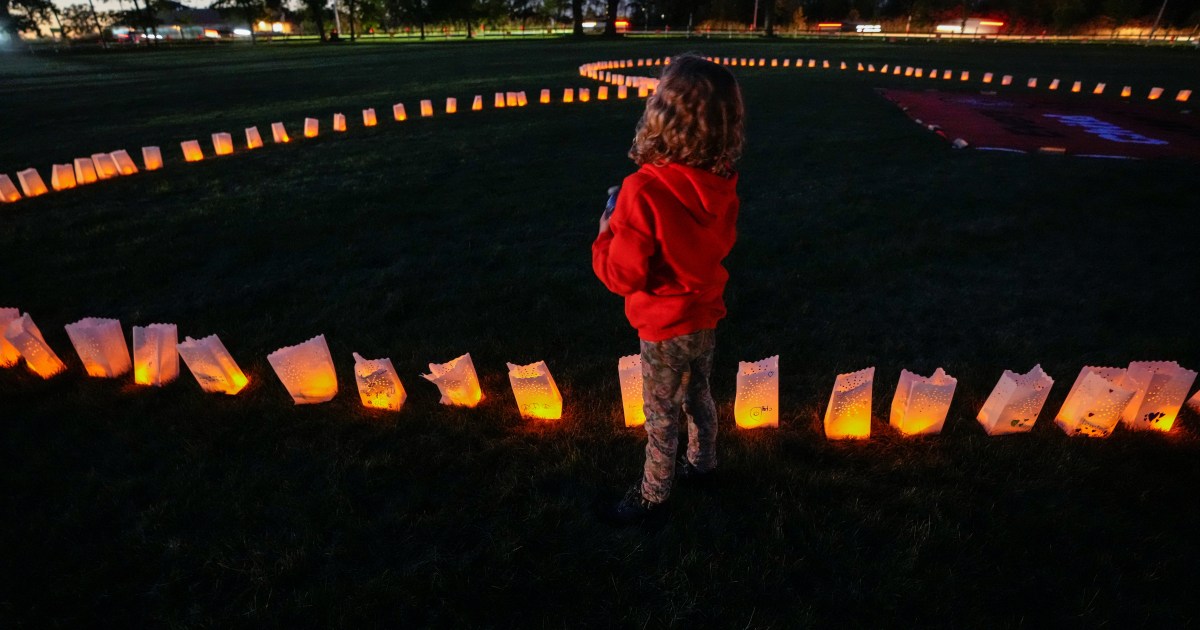
Canada – An Indigenous neighborhood in Canada’s western province of British Columbia has discovered dozens of potential unmarked graves on the grounds of a former residential faculty, the newest such discovery over the previous yr.
Williams Lake First Nation introduced on Monday that preliminary outcomes of the primary section of a geophysical search at St Joseph Mission Residential Faculty uncovered 93 “reflections” – believed to be unmarked gravesites.
“Ninety-three is our quantity,” Chief Willie Sellars informed reporters.
Lots of of unmarked graves have been found at former residential faculty websites throughout Canada since Could, when Tk’emlups te Secwepemc First Nation introduced it had uncovered 215 unmarked graves on the former Kamloops Indian Residential Faculty.
That discovery fuelled widespread requires justice and accountability for the victims and survivors of the forced-assimilation establishments, in addition to calls for that the Canadian authorities launch all information pertaining to the amenities.
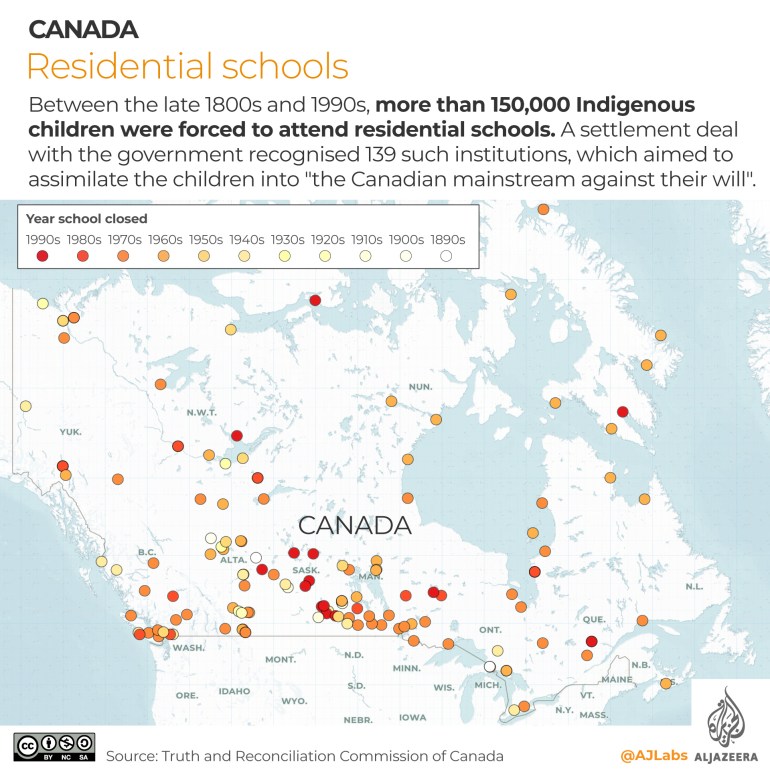
Canada pressured greater than 150,000 First Nations, Inuit, and Metis youngsters to attend residential faculties between the late 1800s and Nineteen Nineties. The kids have been stripped of their languages and tradition, separated from siblings, and subjected to psychological, bodily and sexual abuse. 1000’s are believed to have died whereas attending the establishments, which have been run by numerous church buildings, most notably the Roman Catholic Church.
A federal fee of inquiry into the establishments, referred to as the Fact and Reconciliation Fee (TRC), concluded in 2015 that Canada’s residential faculty system amounted to “cultural genocide”.
1000’s of youngsters from Williams Lake First Nation, in addition to different Indigenous communities, have been pressured to attend St Joseph, which operated as a residential faculty from 1891 to 1981.
“In February 1902, three youngsters ran away from the varsity ensuing within the demise of 1 youngster from publicity and exhaustion. An inquiry into the demise revealed allegations of bodily abuse and poor circumstances on the faculty, together with college students receiving extreme punishment and being pressured to eat rotten meals,” the TRC wrote in a 2004 report (PDF) about circumstances on the establishment.
Williams Lake First Nation launched its investigation into St Joseph Mission Residential Faculty after Tk’emlups te Secwepemc First Nation’s announcement in Could.
Investigators used a variety of geophysical strategies of their search, together with ground-penetrating radar, mentioned Whitney Spearing, who led the neighborhood’s probe of the location. Spearing mentioned 14 out of roughly 470 hectares (1161 acres) have been searched thus far.
“Thus far, 93 reflections have been recorded on the St Joseph’s Mission. All of them show various traits indicative of potential human burials,” Spearing informed reporters, including that investigators imagine 50 of the potential burial websites usually are not related to a historic cemetery on the varsity grounds.
‘Not forgotten footnotes’
Earlier this month, the Canadian federal authorities introduced $1.5m (1.9 million Canadian {dollars}) in funding for the 2021-2022 fiscal yr to assist Williams Lake First Nation examine potential burial websites linked to the previous residential faculty.
“Moreover, work will start to help bringing Elders and Survivors collectively to conduct interviews and share data on unmarked graves, and to collect, plan and host cultural ceremonies inside their neighborhood. This community-led course of will be sure that Williams Lake First Nation can undertake this work in their very own manner and at their very own tempo,” Crown-Indigenous Relations and Northern Affairs Canada, a federal ministry, mentioned in a press release.
Final month, Ottawa additionally mentioned it could launch hundreds of beforehand undisclosed information associated to the residential faculty system.
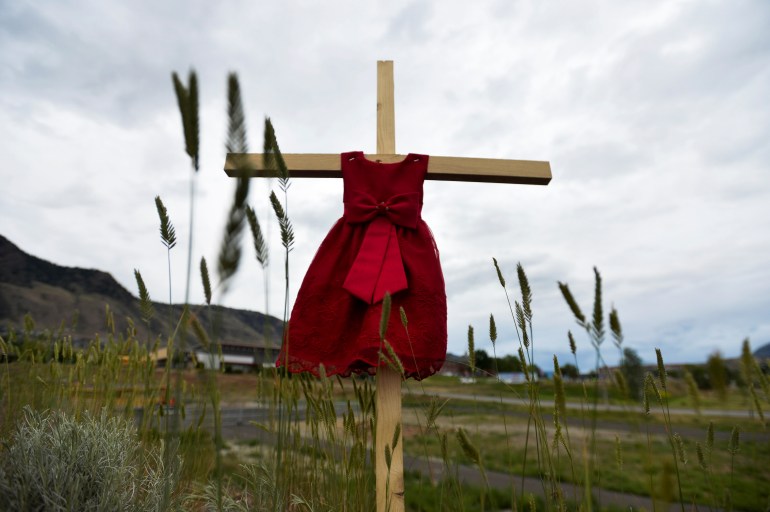 The stays of 215 youngsters, some as younger as three years previous, have been discovered on the web site of the Kamloops Indian Residential Faculty in Kamloops, British Columbia in Could [File: Jennifer Gauthier/Reuters]
On January 20, the federal government mentioned it had reached an settlement with the Nationwide Centre for Fact and Reconciliation (NCTR), a analysis centre that operates out of the College of Manitoba in central Canada, “that outlines how and when Canada will share historic paperwork” associated to the establishments.
“Right this moment’s settlement is one other step alongside the trail set out for us by the Fact and Reconciliation Fee six years in the past,” Stephanie Scott, NCTR’s govt director, mentioned at the moment. “By way of these information, we hope to uncover extra fact on behalf of Survivors, their households, and their communities.”
Sellars, the chief of Williams Lake First Nation, echoed that on Tuesday, saying “a truthful account have to be informed of the previous college students’ residential faculty expertise” earlier than any reconciliation can happen in Canada.
He mentioned survivors have recounted tales of “systematic torture, hunger, rape and sexual assault of youngsters” at St Joseph’s Mission and that “the trauma of people and of communities remains to be very a lot current”.
Intergenerational trauma linked to St Joseph’s Mission and different residential faculties continues to be felt by Indigenous folks throughout the nation, Sellars added. “The abuses suffered at St Joseph’s Mission and different establishments usually are not forgotten footnotes of the previous. The horrors that occurred inside [the] partitions of St Joseph’s Mission are nonetheless very actual for individuals who lived them.”
[ad_2]









Leave a Reply