
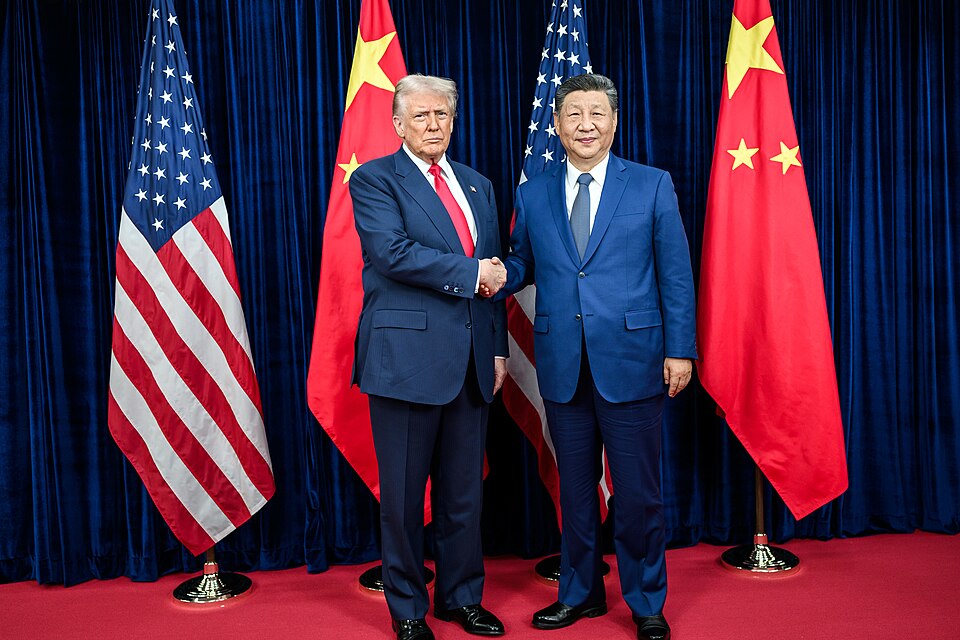
This was shocking to see but China should learn President Trump doesn’t obey anyone’s orders.
China is sending a pointed message to Washington as President Donald Trump prepares for high-level talks with Chinese President Xi Jinping, laying out four sensitive areas that Beijing says the United States should not challenge.
The warning comes during Xi’s September 23–25 state visit to the United States, with trade, Taiwan, artificial intelligence, military competition and other major disputes hanging over the relationship between the world’s two largest economies.
China Draws Four “Red Lines” Ahead of Trump Talks
Chinese Ambassador to the United States Xie Feng outlined Beijing’s position in an article published by China’s state-run People’s Daily.
Xie identified four issues China considers particularly sensitive: Taiwan, democracy and human rights, China’s political and economic system, and what Beijing describes as its development rights.
He argued that China’s sovereignty, security and development interests should not be challenged.
The message effectively establishes boundaries Beijing wants Washington to respect as Trump and Xi meet for another round of closely watched diplomacy. Reuters reported the warning Wednesday as Xi arrived for his state visit.
Taiwan Could Be One of the Biggest Issues
Taiwan remains one of the most serious sources of tension between the United States and China.
Beijing claims the self-governing island as part of China and strongly objects to American military support for Taiwan. Taiwan has its own democratically elected government and rejects Beijing’s sovereignty claims.
The United States does not maintain formal diplomatic relations with Taiwan, but federal law requires Washington to provide the island with the means necessary for its self-defense.
Trump has continued approving significant U.S. arms sales to Taiwan during his second term, while China has repeatedly called for those sales to end. Reuters reported that Xi is expected to press Trump on the issue during the Washington talks.
That makes Taiwan one of the clearest tests of how the Trump administration will balance diplomacy with Beijing against America’s longstanding security commitments in the Indo-Pacific.
Trump Gives Xi a High-Profile Welcome
Despite major disagreements between the two countries, Trump is giving Xi an unusually prominent reception.
Trump personally welcomed Xi and his wife, Peng Liyuan, at Joint Base Andrews Wednesday evening. Sitting presidents normally receive visiting foreign leaders at the White House, making the airport greeting an uncommon diplomatic gesture.
The White House visit also includes an official arrival ceremony involving nearly 500 members of the U.S. military.
A B-2 Spirit stealth bomber and four F-22 fighter jets are expected to participate in a military flyover during the ceremony.
Trump and Xi are scheduled to hold formal talks Thursday before attending a state dinner that evening.
Xi’s visit is his first U.S. state visit in more than a decade and follows Trump’s trip to Beijing earlier in 2026.
Republican Senator Questions Xi’s Reception
The elaborate welcome is drawing criticism from some members of Congress.
Senate Armed Services Committee Chairman Roger Wicker, a Mississippi Republican, said he would have advised Trump against providing Xi with such an extensive reception.
Wicker pointed to longstanding American concerns involving China’s military expansion, political system and ambitions in the Indo-Pacific.
Democratic lawmakers have also raised concerns about Beijing, including China’s relationships with Iran and Russia.
The reaction demonstrates that congressional skepticism toward Beijing extends across party lines, even as presidents from both parties have maintained direct diplomatic contact with Chinese leaders.
Trade, Technology and American Jobs Are Also at Stake
The summit extends well beyond Taiwan.
Trump and Xi are dealing with disputes involving tariffs, semiconductor technology, artificial intelligence, rare-earth minerals and agricultural trade.
The United States has attempted to restrict China’s access to some advanced technologies, particularly sophisticated computer chips used for artificial intelligence.
China, meanwhile, controls a major share of the global supply chain for critical rare-earth materials used in electronics, military equipment and advanced manufacturing. Trade negotiations also remain important for American farmers and manufacturers seeking access to the massive Chinese market.
The two governments are also deciding whether to extend their current tariff truce, making the economic consequences of the summit potentially significant for American businesses and consumers.
Why the Trump-Xi Meeting Matters
For Americans, the dispute between Washington and Beijing is about much more than diplomatic ceremony.
China is one of America’s largest economic competitors and a rapidly expanding military power. Decisions made during these talks could affect manufacturing, agriculture, technology, national security and the future stability of the Indo-Pacific region.
Beijing has now made its priorities clear by publicly identifying the issues it considers off limits.
Trump, meanwhile, enters the meetings facing the challenge of pursuing economic agreements with China while maintaining longstanding U.S. positions on Taiwan, national security and technological competition.
What happens during Xi’s visit could help shape U.S.-China relations for years to come.



Leave a Reply