
[ad_1]
By Dr Raghuram Y.S. MD (Ay) & Dr Manasa, B.A.M.S
Iliotibial Band is a thick band of fascia. It’s shaped by the fascia of the under talked about muscle mass – gluteus maximus, gluteus medius and tensor fasciae latae. Iliotibial Band is abbreviated as ITB. It’s proximally shaped on the hip by this fascia.
The ITB runs from the hip to the knee cap. It runs alongside the lateral a part of the thigh. Additionally it is an necessary construction which is concerned within the actions of your legs. The band will get inserted to Gerdy’s tubercle. It doesn’t have any bony attachment alongside the femur bone. Consequently it tends to shift entrance to again as and when knee flexes and extends.
Learn – Pratyangas: The minor organs, Definition, Quantity

The tract passes superficial to the Vastus Lateralis muscle and will get inserted primarily on the Gerdy tubercle of the lateral tibial plateau and in addition partially to the supracondylar ridge of the lateral a part of the femur. The Iliopatella band is its anterior extension. It connects the lateral a part of the patella (small bony prominence on the entrance of knee joint which you could really feel). This prevents the medial translation of the patella. In between the ITB and lateral femoral epicondyle we will discover a small recess. This house comprises lateral synovial recess (a synovial extension of the knee joint capsule). Superior and inferior gluteal nerves provide ITB. The identical nerves provide gluteus maximus and tensor fasciae latae.

The band is usually made up of collagen fibres. Collagen being the strongest protein would permit higher power absorption with weight bearing actions. In between the collagen layers small quantities of elastin fibres are additionally current. This is able to permit the band to be barely elastic and pliable. This is able to assist the band to behave like a spring. Regardless of this the band can’t be stretched like a muscle.
Learn – Shaareera: Ayurvedic Examine Of Anatomy And Physiology

Features of ITB
Proximally the band helps in extension, abduction and lateral rotation of the hip. Distally its capabilities rely upon the knee joint place. The ITB mendacity anterior to the lateral femoral epicondyle is an energetic knee extensor and permits full extension to 20-30 levels of flexion. The ITB mendacity posterior in relation to the lateral femoral epicondyle is an energetic knee flexor and permits 20-30 levels of flexion to full flexion vary of actions.
Learn – Avascular Necrosis In Ayurveda – Causes, Signs, Remedy
Iliotibial Band Syndrome (ITBS)
Iliotibial Tract Syndrome is among the scientific circumstances manifested because of ITB dysfunction. ITBS occurs when the ITB will get irritated or swollen from rubbing in opposition to the hip or knee bones. It rubs in opposition to the bones when it will get too tight i.e. tensed.
It normally presents as sharp or aching ache on the skin of the knee or hip joint. This is because of a decent ITB. If the affected person is an athlete experiencing these signs the analysis of iliotibial band syndrome is sort of positive. This situation occurs when the bothered band which is swollen and irritated rubs in opposition to the talked about bones of hip or knee. Many different signs will also be manifested as a result of swelling and irritation of the band. Bodily remedy, medicines or surgical procedure (not often) may assist in easing the situation and these therapies are sometimes utilized in mixtures. ITBS can occur both in a single leg or each legs. When it’s current in each legs it’s referred to as bilateral ITBS.
Learn – Efficient Ayurveda therapies for Knee Osteo Arthritis (SandhiVata)
Threat elements
Younger individuals, particularly those that train incessantly are at greater threat for ITBS. Athletes most liable to this situation embody cyclists, runners, skiers and those that play basketball, hockey or soccer. ITBS is most typical in those that incessantly train and in athletes. Ati vyayama i.e. extreme indulgence in workouts and sports activities are the most typical and necessary causes for vata aggravation. However, vata aggravation on this band may cause ITBS.
Different threat elements –

Incidence
- It’s seen that ITBS is widespread in these present process coaching for U.S. Marines, at roughly 20% individuals.
- Frequent runners are extra susceptible for ITBS, primarily lengthy distance runners.
- ITBS accounts for about 12% of working accidents.
- Extra females have ITBS compared to males.
- ITBS is among the many causes of knee ache and impacts about 25% of adults.
Causes
When the ITB will get stretched too tight and rubs in opposition to the bone it could get irritated and swollen. Under talked about are the attainable causes of a decent ITB –
- Extreme foot pronation which stretches the ITB and brings it nearer to the bones
- Weak point of the abductor muscle mass of the hip may tense up the ITB
- Inner tibial torsion whereby the shinbone is twisted inwards pulling the ITB nearer to the bones
- Arthritis of the medial compartment of the knee joint which results in a situation referred to as genu varum which in flip pulls in your ITB making it tight
- Preexisting ITB tightness (if the situation persists since beginning)
The ITB may additionally rub in opposition to your bones because of the under talked about causes –
- Pushing oneself too laborious throughout train and doing it past capability and limits
- Insufficient relaxation
- Not stretching sufficient earlier than exercising
- Warming up too shortly earlier than going into train
- Cooling down too quick after exercising
- Operating on a curved or tilted floor / uneven floor
- Operating downhill
- Sporting worn-out footwear
Learn – Completely different Causes For Vata Dosha Imbalance, Improve
Signs of ITBS
The signs of ITBS are brought on by a tense ITB. The signs of ITBS are as under talked about –
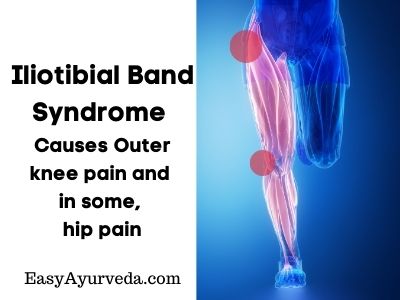
Hip Ache – is brought on because of the repeated rubbing of ITB on the higher trochanter within the hip. This friction causes irritation within the tendon and hip ache together with a attainable snapping sound within the joint.
Knee Ache – occurs when your tense ITB rubs repeatedly in opposition to the lateral epicondyle as you flex and prolong your knee joint. The friction causes irritation within the tendon and knee ache.
Redness and heat – may be noticed on the skin of the bothered knee joint.
Learn – Classification Of Ache And Arthritis As Per Ayurveda
Nature of Ache in ITBS
The ache would begin after your train at first. Because the signs worsen the ache is felt total course of the train. Finally you’ll really feel the ache whereas resting additionally. The preliminary ache of ITBS is usually described as ‘aching and burning’. The extra the train, the more serious the syndrome and sharper the ache seems to be.
Problems of ITBS
ITBS could trigger PFPS (Patello Femoral Ache Syndrome) as a complication. Along with the knee and hip ache the affected person may additionally really feel ache round and in addition underneath the kneecap (patella).
Prognosis of ITBS
Your ITBS may heal after relaxation, bodily remedy and medicines, normally a mixture of all. Immediate therapy and skilful administration is the important thing in the direction of treating ITBS comprehensively.

When correct therapy, particularly nonsurgical therapy is run, enchancment may be seen after about 4-8 weeks in about 50-90% individuals with ITBS. In keeping with some research enchancment is seen inside 2-6 weeks. With out therapy ITBS can worsen with time. Due to this fact the affected person wants to talk to the healthcare supplier about bodily remedy, medicines or different therapies which might work.
Learn – Train Timing, Advantages, Facet Results, Ayurvedic Administration
Analysis
Historical past, examination and indicators
The doctor will attain a conclusive analysis of ITBS on the idea of the affected person’s historical past and signs and after having carried out a whole bodily examination. The physician would test for the under talked about indicators too –
Crepitus – grating sounds / feeling when there’s motion in knee or hip
Ache over the higher trochanter – in a single or each hips
Ache over the lateral epicondyle – in a single or each knees
Ache that will increase alongside the size of your train
Ache will get worse if you go downhill
Exams to diagnose ITBS
The doctor could perform Noble and Ober assessments to diagnose ITBS. Renne’s Check may additionally be carried out.
Associated Video – Noble Check
Associated Video – Ober Check
Associated Video – Renne’s Check
The under talked about imaging assessments may additionally be required to achieve on the appropriate analysis of ITBS –
MRI – helps in excluding different accidents like meniscal tear or lateral collateral ligament harm
Ultrasound – reveals how your ITB strikes if you flex and prolong your hip or knee and thus helps in proving the presence of ITBS
Prevention
It’s tough to stop this situation particularly in case you are a sportsperson or athlete. You might strive altering the methods through which you do these actions in order to cut back the danger of ITBS. Examples are as talked about under –
- Keep away from working uphill or downhill or any slanted/uneven floor
- Handle proper strategies in no matter exercise you might be indulged into
- Give sufficient time on your physique to recuperate between exercises or occasions
- Shift your coaching depth in a gradual method, velocity up slowly when you’re biking as a substitute of all of a sudden switching from sluggish to quick or from quick to sluggish
- Give loads of time to correctly stretch, warm-up and funky throughout exercising
- Decelerate your heat ups and funky downs
- Stretch your IT band, hip muscle mass, thigh muscle mass and hamstring muscle mass usually
- Alter your sample of working, run with a shorter stride and flat surfaces
- Exchange the footwear you put on frequently
- Put on supportive footwear
- Use foam curler to loosen up your IT band
Learn – Sciatica – Ayurvedic Understanding And Profitable Remedy Choices
Remedy
Some therapies for ITBS may be accomplished at house and different kinds of therapy may need to be accomplished by an professional doctor. Each these methods shall be blended skillfully to acquire higher outcomes.
The most typical ITBS therapies embody –
Relaxation – Relaxation your bothered leg and don’t indulge it within the train till the ache has gone away and ITBS has healed (in response to some consultants). Healthcare supplier will information the amount of relaxation and exercise you need to endure whereas underneath therapy.
Medicines for ache administration – common consumption of NSAIDs together with Ibuprofen and Naproxen. These medicines needs to be taken underneath medical supervision.
Guide remedy – this consists of use of froth curler to therapeutic massage physique underneath the steering and directions of a bodily therapist.
Bodily remedy – you may need to apply sure efficient stretches, strengthening workouts and different therapies to assist relieve hip and knee ache underneath the steering of a bodily therapist. These assist in lengthening ITB and in addition to lower the stress therein. Additionally, you will be taught to heat up earlier than train and funky down after train in higher methods.
Posture Coaching – will assist you to carry your physique in a greater throughout every day actions, taking part in sports activities and so on.
Steroid injections – would scale back irritation of ITB.
Surgical procedure – is uncommon however is likely to be advisable if medicines and bodily remedy doesn’t work.
Learn – Ayurvedic Residence Treatment For Sciatica, Rheumatoid Arthritis With Haritaki
Dwelling with ITBS
The sufferers with ITBS can be nervous in order to after they can get again to their regular actions. They’ll slowly get again to their common actions as soon as their ache has been relieved to a higher extent, in fact with the permission and steering of their healthcare supplier. One also can make plans to take care of this situation and cope up with it. She or he shall additionally work out what actions they’ll do and when to do them safely with the assistance of a healthcare supplier. Additionally it is necessary to know concerning the illness. If it’s the first time one is experiencing hip or knee ache as per the outline in ITBS one ought to contact their healthcare supplier. They need to instantly contact a healthcare supplier or specialist particularly when one doesn’t get higher after just a few weeks or will get even worse.
Put together a listing of indicators and signs and queries which it’s essential to focus on with physician. The questions could also be associated to the causes, investigations wanted, therapy and physiotherapy suggestions, want of surgical procedure, preventive measures, coping with the issue inside house or about getting again to regular actions.
Finest Yoga postures for ITBS
Gomukhasana – Cow Face Pose
Half cow pose – Ardha Gomukhasana
Ardha Matsyendrasana – Half Lord of the Fishes Pose
Uttanasana (variant) – Ankles Crossed Standing Ahead Fold
Paschimottanasana (variant) – Ankles Crossed Seated Ahead Fold
Agnistambhasana – Hearth log Pose
Parivrtta Ardha Hanumanasana – Revolved Half Cut up
Parivrtta Trikonasana – Revolved Triangle Pose / Twisted Triangle
Parsvottanasana – Pyramid Pose
Uttanasana (variant) – Crossed Legged Broad Standing Ahead Fold
Ardha Chandrasana (variant) – Crossed Ankle Standing Half Moon Pose
Kapotasana – Pigeon Pose
Supta Kapotasana – Reclined Pigeon Pose
Phalakasana (variant) / Vasishtasana – Plank with leg extension
Different poses
Anjaneyasana – Low Lunge / Kneeling lunge with a twist
Supta Hasta Padangusthasana – Reclining Hand-to-big toe Pose
Utthana Prishtasana – Lizard Pose
Shalabasana – Locust Pose
Jathara Parivritti – Revolved Stomach Pose
Ayurveda Understanding Of Iliotibial Band Syndrome (ITBS)
We can’t immediately discover any situation resembling the scientific image of ITBS in Ayurveda treatises. I’ve tried to compile the scattered references of circumstances nearer in clarification to ITBS. This can even be an understanding of this painful situation compared to completely different views of the identical as defined within the fashionable texts.
Efficient Ayurveda therapies for Knee Osteo Arthritis (SandhiVata)
From anatomical and physiological perspective
The principle capabilities of ITB are stabilisation of the pelvis and controlling the posture. Stability and posture upkeep are the capabilities of vata. Vata is invariably imbalanced in ITBS.
ITB is shaped by collagen and elastin fibres which might permit it to be elastic and pliable barely. Presence of collagen would additionally permit higher power absorption when one is indulged in weight bearing actions. When vata dominates or is severely aggravated or in these of vata structure who’re susceptible for painful problems, the collagen and elastin fibres lose their composition and integrity additional resulting in lack of elasticity and suppleness of ITB. Hardness and dryness in ITB happens because of the similar qualities of vata that are elevated. This additionally displays deterioration of kapha in these buildings. Pitta may additionally be elevated which worsens the image in some circumstances because of the onset and development of irritation. All these occasions result in the manifestation of ITBS. Quite the opposite lack of elastin and collagen additionally could result in vata enhance.
Learn – Signs Of Vata Dosha Improve And Imbalance – Vata Vruddhi Lakshana
From the angle of pathogenesis of ITBS
The ITB is concerned in causation of many actions within the hip and knee joints. Actions on the joints are brought on by balanced vata and kapha (shleshaka kind of kapha). When there happens imbalance in these vata and kapha added with publicity to etiological elements like extreme train and so on will predispose one to develop ITBS. Total ITB dysfunction which causes ITBS is brought on by vata aggravation.
Learn – Train Timing, Advantages, Facet Results, Ayurvedic Administration
From the angle of etiological elements
- ITBS is most typical in those that incessantly train and in athletes. Extreme participation in workouts and athletics are subsequently the primary causes of ITBS. Ati vyayama i.e. extreme indulgence in workouts and sports activities are the most typical and necessary causes for vata aggravation. However, vata aggravation on this band may cause ITBS.
- Different causes embody bowed legs, having disproportionate decrease limbs and inward rotation of ankle, leg or foot. Vata aggravation is liable for all these circumstances.
- Knee arthritis may additionally trigger ITBS. Placing it in Ayurveda phrases, ITBS is likely to be brought on by aggravation of vata within the joints i.e. sandhigata vata.
- An excessive amount of tightening of ITB is likely to be brought on by vata aggravation. Extreme stretching of ITB and its rubbing in opposition to the bone may cause vata aggravation and this in flip causes signs of ITB which additionally appear to seem like signs brought on by vata aggravation. Causes of ITB tightness defined above are also brought on by vata aggravation. These embody extreme foot pronation, weak point of hip muscle mass, inner tibial torsion, arthritis of knee joint and so on.
- The causes as a result of which the ITB rubs in opposition to the bones even have a hyperlink with vata aggravation. Operating on curved or tilted / uneven surfaces or downhill or sporting worn-out footwear may put the limb in untoward postures that are the chief causes for vata aggravation.
Learn – OsteoArthritis Signs, Prevention, Life-style ideas, Ayurvedic therapy
From the signs perspective
ITBS normally presents as sharp or aching ache on the skin of the knee or hip joint. This is because of a decent ITB. If the affected person is an athlete experiencing these signs the analysis of iliotibial band syndrome is sort of positive. Ache and tightness are options of vata aggravation. Vata can be aggravated by extreme train.
From the signs perspective the under talked about circumstances defined in Ayurveda may be thought of as ITBS –
Uru sandhi shula / Uru sandhigata vata
Janu sandhi shula / Janu sandhigata vata
Different circumstances which may be thought of embody –
Urushula
Vatarakta
Urugata Vata Prakopa
Nature of ache – Because the ache begins and will get aggravates together with and after train the scientific image and look of signs mimics these occurring as a result of vata prakopa. We have to be aware that vata will get aggravated after extreme train as a rule. Aching and burning ache of ITBS suggests involvement of pitta additionally within the illness together with vata. Redness and heat over the bothered knee joint too displays the involvement of pitta within the pathogenesis of ITBS. Crepitus can be current within the bothered joint / joints. Shula i.e. ache and atopa i.e. crepitus together with swelling of the bothered joints is the hallmark function of sandhigata vata. PFPS which is a complication of ITBS additionally resembles sandhigata vata occurring within the knee joint.
Learn – Growling Abdomen Causes, Signs, Remedy, Ayurveda Idea
From therapy perspective
Even from the therapy perspective, the fashionable interventions for ITBS resemble the vata mitigating measures adopted in Ayurveda. Relaxation, ache administration, handbook, bodily and postural coaching all are anti-vata interventions.
Remedy of ITBS
ITBS shall be handled on the strains of –
- Vata chikitsa – therapy of aggravated vata is desired.
- Urugata Vata Prakopa – therapy of aggravation of vata within the thigh / thighs needs to be used.
- Pitta chikitsa – therapy of aggravated pitta needs to be accomplished when indicators and signs of pitta vitiation are present in ITBS.
- Sandhigata Vata Chikitsa – therapy of joints bothered by aggravated vata – arthritis / osteoarthritis of joints match into the therapy protocol.
- Uru sandhi shula / Uru sandhigata vata – ache in hip joint or arthritis of hip joint
- Janu sandhi shula / Janu sandhigata vata – ache in knee joint or arthritis of knee joint
- Snayugata Vata Chikitsa – therapy of ligaments / tendons bothered by aggravated vata.
- Urushula – therapy of ache within the thighs needs to be thought of.
- Vatarakta Chikitsa – therapy of simultaneous aggravation of vata and blood consequently afflicting the joints and tender tissues / therapy of gouty arthritis.
Therapies
ITBS shall be handled on the idea of predominant etiological elements and predominantly manifested signs. Under talked about therapies can be extremely efficient within the therapy of ITBS.
Exterior Therapies
- Abhyanga and Swedana – natural oil therapeutic massage and sudation on the bothered joints (hip and knee) and thigh helps in relieving vata aggravation, ache, and tightness. It improves vary of motions and enhances flexibility. These two therapies are normally mixed for extra impact.
- Amongst swedana – patrapinda sweda (leaf bolus sudation) assist in relieving the signs of ITBS together with ache and shashtika shali pinda sweda (medicated rice bolus sudation) helps in strengthening and supporting the joints.
- Dhara – stream pouring of heat medicated vata assuaging oils and milk needs to be used.
- Sthanika Vasti – oil pooling on bothered joints i.e. hip (uru vasti) and knee (janu vasti) will assist.
- Pichu – cotton pads / swabs dipped in vata mitigating oil is saved on the bothered joints according to ITB and bandaged if essential.
- Lepa – anointments ready with paste of vata / pitta mitigating herbs shall be utilized on the bothered elements.
- Upanaha – poultice ready with paste of vata / pitta mitigating herbs and medicated oils shall be utilized on the bothered elements.
Inner Remedy
- Snehapana – oral administration of medicated fat (ghee / oil) in metered doses. If therapeutic purgation is deliberate to expel morbid pitta, medicated ghee is given in growing doses over a interval of 3-5 days or till the purpose of saturation is reached. Every day small doses of medicated fats (nitya sneha pana) too are useful to mitigate vata and in addition to alleviate ache and different signs.
- Virechana – therapeutic purgation is a perfect treatment for each vata and pitta aggravation. Unctuous purgatives shall be given in case of vata aggravation in ITBS.
- Vasti – enema with oil or ghee or each ready with vata / pitta mitigating herbs is the very best treatment for relieving signs of ITBS and in addition to alleviate vata.
Ayurvedic Medicines

Maharasnadi Kashayam
Sahacharadi Kashayam
Rasnasaptakam Kashayam
Gandharvahastadi Kashayam
Kokilaksham Kashayam
Guluchyadi Kashayam
Trayodashanga Guggulu
Rasnadi Guggulu
Mahayogaraja Guggulu
Kaishora Guggulu
Click on to Seek the advice of Dr Raghuram Y.S. MD (Ayu) – Skype
[ad_2]









Leave a Reply