
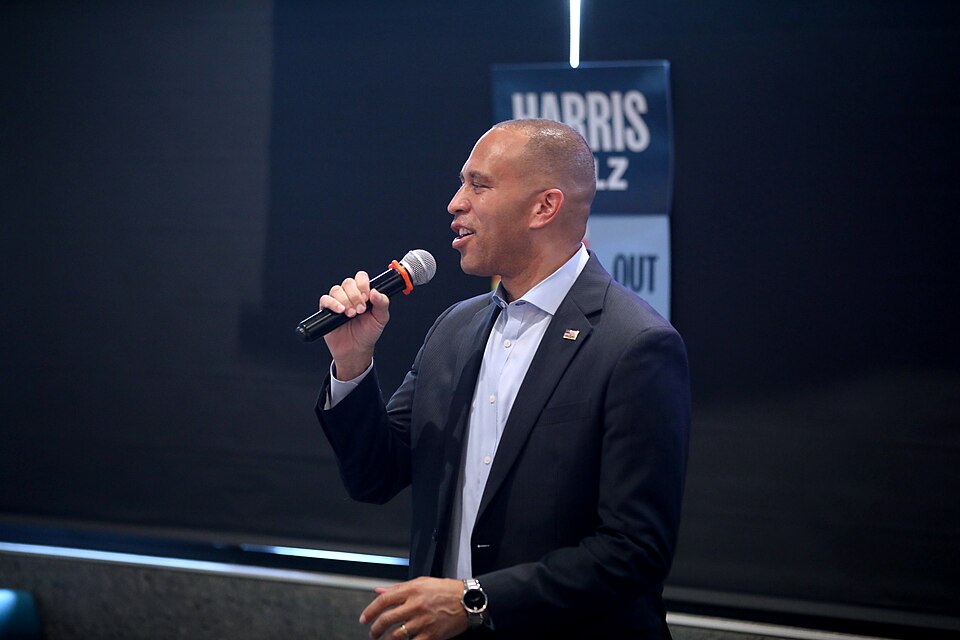
Democrats have egg on their faces.
House Minority Leader Hakeem Jeffries suffered an embarrassing political setback after two Democrats broke ranks and provided Republicans with the crucial votes needed to advance a resolution condemning socialism and supporting election integrity.
The House ultimately approved the resolution Tuesday evening by a 220-192 vote, with Republicans unanimously backing the measure and opposition coming entirely from Democrats.
But the final vote wasn’t the biggest surprise.
Hours earlier, Republicans were on the verge of watching their legislative plans collapse after five GOP lawmakers rebelled against a critical procedural vote.
Then two Democrats stepped in.
Reps. Jared Golden of Maine and Marie Gluesenkamp Perez of Washington crossed party lines and supplied Republicans with the votes they needed to keep the House moving.
Their decision reportedly caught Jeffries and Democratic leadership by surprise — and sparked an immediate backlash inside the party.
Two Democrats Rescue Republicans In Dramatic House Vote
The controversy began with what is known as a House “rule vote.”
While procedural votes rarely attract widespread attention outside Washington, they are enormously important because they determine whether legislation can move forward for debate and a final vote.
Republicans needed the rule to advance several pieces of legislation, including the resolution condemning socialism.
But five Republican lawmakers refused to support it.
That put GOP leaders on the brink of defeat.
Golden and Gluesenkamp Perez then voted with Republicans, allowing the rule to pass by the narrowest possible margin: 209-208.
Without those two Democratic votes, Republicans would not have had enough support to advance their agenda.
The unusual move apparently came without warning to Democratic leadership.
Jeffries told reporters that he had not been notified beforehand.
Jeffries Warns Of Consequences
The response from House Democratic leaders was swift.
Jeffries and other senior Democrats accused their two colleagues of blindsiding the caucus and described their actions as a serious “breach of trust.”
Democratic leaders said the two lawmakers caught the entire House Democratic Caucus off guard by joining Republicans to save a procedural vote that was headed for defeat, calling the move a serious violation of trust.
They went further, warning that the episode required a “serious response.”
Democratic leadership said the matter would be referred to the Committee on Caucus Rules for consideration.
That raises the possibility of internal consequences for Golden and Gluesenkamp Perez, although Democratic leaders did not immediately specify what action could ultimately be taken.
The confrontation underscores the difficulties Jeffries faces in maintaining party unity as Democrats prepare for the 2026 midterm elections.
House Votes To Condemn Socialism
After clearing the procedural hurdle, Republicans brought their resolution to the House floor.
It passed 220-192.
The measure condemns socialism, reaffirms support for the U.S. Constitution and backs election-integrity efforts.
It also calls for passage of the Safeguarding American Voter Eligibility Act, better known as the SAVE Act.
The SAVE Act has become another major partisan dividing line, with Republicans arguing that stronger citizenship-verification requirements are necessary to protect federal elections and Democrats raising concerns about how such requirements could affect eligible voters.
Senior Democratic leaders opposed the overall resolution.
Jeffries voted no, as did House Minority Whip Katherine Clark of Massachusetts and House Democratic Caucus Chairman Pete Aguilar of California.
But once again, not every Democrat followed leadership.
Eight Democrats Join Republicans
Golden and Gluesenkamp Perez were among eight Democrats who ultimately voted with Republicans for the anti-socialism resolution.
They were joined by Democratic Reps. Don Davis of North Carolina, Vicente Gonzalez and Henry Cuellar of Texas, Kathy Castor and Darren Soto of Florida, and Gabe Vasquez of New Mexico.
Democrats Maggie Goodlander and Chrissy Houlahan voted “present.”
The defections gave Republicans an opportunity to highlight ideological divisions within the Democratic Party at a politically sensitive moment.
With control of Congress at stake in November, socialism and the Democratic Party’s progressive wing have increasingly become targets of Republican midterm messaging.
Socialism Emerges As A Major 2026 Issue
Republicans have spent months warning voters that socialist-aligned activists and candidates are gaining influence within the Democratic Party.
Those arguments have intensified as candidates associated with or supported by the Democratic Socialists of America challenge more traditional Democrats around the country.
Republicans see an opportunity.
Their strategy is to force Democratic candidates — particularly those competing in politically moderate districts — to answer whether they support policies associated with the party’s furthest-left faction.
Tuesday’s vote gave the GOP another opening to make that case.
Republican Study Committee Chairman August Pfluger of Texas argued that lawmakers should be required to make their positions clear.
“Socialism has failed everywhere it’s been tried without exception,” Pfluger told Fox News Digital.
He argued that the House vote put lawmakers on record and gave Americans an opportunity to see where their representatives stand.
Republican Says Choice Should Be Simple
Colorado Republican Rep. Jeff Crank, who led the resolution, portrayed the measure as a straightforward statement of American principles.
According to Crank, the resolution does three primary things: condemns socialism, reaffirms lawmakers’ commitment to the Constitution and supports preventing non-citizens from voting in American elections.
For Republicans, those positions could provide useful campaign material heading into November.
The GOP is fighting to maintain control of Congress, and Republican candidates are expected to contrast their policies with the increasingly influential progressive wing of the Democratic Party.
The vote gives them an official congressional record to point toward.
Democrats, however, see things very differently.
Democrats Call Vote A Political Distraction
Democrats argued that the Republican resolution amounted to political theater rather than meaningful legislation addressing Americans’ everyday concerns.
Massachusetts Democratic Rep. Jim McGovern criticized Republicans for focusing on a non-binding resolution while families remain concerned about household expenses.
McGovern pointed specifically to gasoline and grocery prices, arguing that Congress should focus its attention on affordability rather than symbolic political votes.
Democrats have similarly criticized Republican election-integrity proposals, with opponents warning that stricter voting requirements could create additional obstacles for eligible Americans.
Republicans reject that argument and maintain that citizenship verification and other safeguards are common-sense protections that can strengthen public confidence in elections.
The disagreement provides voters with another clear contrast between the two parties heading into the midterms.
Why Five Republicans Rebelled
Ironically, Democrats were not the only party dealing with internal divisions.
Five Republicans nearly prevented the resolution from reaching the floor in the first place.
Reps. Pete Sessions and Chip Roy of Texas, Ralph Norman of South Carolina, Clay Higgins of Louisiana and Andy Harris of Maryland voted against the procedural rule.
Their opposition was not primarily aimed at the anti-socialism resolution.
Instead, the conservatives were protesting how Republican leaders handled legislation designed to prevent a federal government shutdown before the midterm elections.
The dispute centered on a short-term government funding measure known as a continuing resolution, or CR.
The Senate modified the House-approved version, including changes involving federal grants and a temporary delay connected to restrictions on certain hemp products.
Those alterations angered the five Republican lawmakers.
Their protest unexpectedly gave Democrats the ability to derail the Republican agenda — until Golden and Gluesenkamp Perez intervened.
Golden Had Another Major Issue At Stake
Golden also had a practical reason to keep the legislative process moving.
The Maine Democrat is a co-leader of legislation seeking to pause new federal restrictions affecting parts of America’s lobster and crab fishing industries.
That is an especially important economic issue in Maine.
His legislation could also have been stalled if the House rule failed.
Golden is not running for re-election, which gives him considerably different political considerations from many of his Democratic colleagues.
Gluesenkamp Perez, meanwhile, represents a competitive district and is considered among the more politically vulnerable House Democrats heading into November.
Both have established reputations for occasionally breaking with their party.
Still, helping the opposing party pass a procedural rule is highly unusual in the House.
Jeffries Faces A Democratic Unity Problem
For Jeffries, the political problem extends beyond a single resolution.
House leaders rely heavily on party unity during procedural fights because even a handful of defections can completely change the outcome when congressional margins are narrow.
This time, Republicans had their own rebellion.
But instead of allowing the GOP’s internal dispute to sink the Republican agenda, two Democrats effectively rescued it.
That explains why Democratic leadership reacted so strongly.
Republicans, meanwhile, walked away with a victory they can use during the midterm campaign: a House vote officially condemning socialism and supporting their election-integrity message.
Even more awkwardly for Democratic leaders, they received that opportunity because two members of Jeffries’ own caucus helped make it possible.
The episode also reveals a broader challenge facing both parties ahead of November.
Republicans are managing disagreements between leadership and conservatives, while Democrats are confronting tensions between progressives, party leaders and members representing more politically competitive constituencies.
For voters, Tuesday’s chaotic series of votes provided a revealing look at those divisions.
And for Jeffries, what began as a Republican revolt ended with two Democrats crossing the aisle, Republicans advancing their agenda and Democratic leadership demanding answers from within its own ranks.








Leave a Reply