
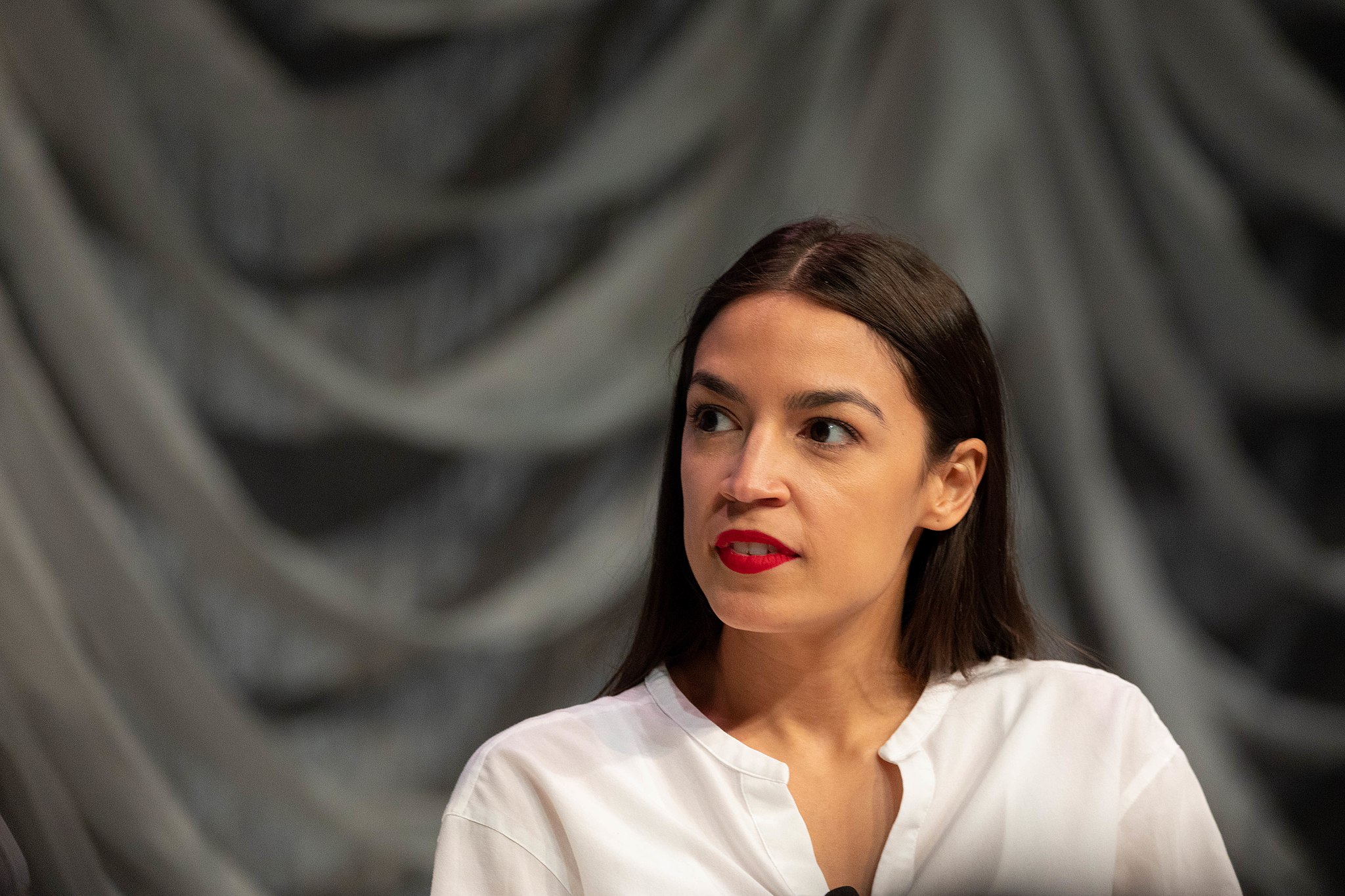
Ocasio-Cortez still found a reason to complain about something good.
House Republicans secured a major legislative victory after passing a bill that would significantly tighten restrictions on congressional stock trading while also adding a controversial voter ID requirement. Supporters say the proposal would strengthen ethics and restore public confidence in Congress, while critics argue it combines two separate issues into one sweeping piece of legislation.
The Stop Insider Trading Act passed the House by a 232-198 vote, receiving unanimous Republican support along with votes from 13 Democrats.
Those Democrats included Reps. Henry Cuellar (Texas), Jared Golden (Maine), Josh Gottheimer (New Jersey), Kathy Castor (Florida), Jared Moskowitz (Florida), Chris Pappas (New Hampshire), Susie Lee (Nevada), Marcy Kaptur (Ohio), Don Davis (North Carolina), Vicente Gonzalez (Texas), Darren Soto (Florida), Marie Gluesenkamp Perez (Washington), and Derek Tran (California).
Voter ID Provision Sparks Opposition
One of the bill’s biggest flashpoints is a voter ID provision requiring voters to present photo identification when casting a ballot.
Supporters argue the measure would strengthen election integrity and increase confidence in the voting process. Opponents contend it could create new obstacles for some eligible voters and believe the election language should not have been included alongside congressional ethics reforms.
Rep. Alexandria Ocasio-Cortez (D-N.Y.) sharply criticized the legislation, arguing Republicans were using the stock trading proposal to advance broader election reforms.
“Republicans are trying to pull a trick this week,” Ocasio-Cortez wrote on social media. She argued that the legislation combines an insider trading proposal with voter ID provisions that she believes could affect mail-in voting.
She ultimately voted against the bill.
Because of the voter ID language, many political observers believe the legislation could face significant hurdles in the Senate, where most major legislation requires 60 votes to overcome a filibuster.
What the Bill Would Change
If signed into law, the legislation would represent one of the most significant congressional ethics reforms since lawmakers approved the STOCK Act in 2012.
Under the proposal:
- Members of Congress, their spouses, and dependent children would generally be prohibited from purchasing individual publicly traded stocks while in office.
- Limited exceptions would remain for certain diversified investment funds.
- Lawmakers would have to provide advance notice—between seven and fourteen days—before selling covered stocks.
- Violations could result in financial penalties and House ethics investigations.
Supporters say the legislation would reduce conflicts of interest and help rebuild public trust in Congress.
Critics, however, argue it does not amount to a complete stock trading ban because lawmakers would still be allowed to sell investments under certain conditions.
Why This Matters
Congressional stock trading has become one of the most debated ethics issues in Washington over the past decade. Critics from both political parties have questioned whether lawmakers should be allowed to trade individual stocks while voting on legislation that could affect financial markets.
The bill represents Congress’s latest attempt to address those concerns while increasing transparency surrounding lawmakers’ financial activity.
Lawmakers With Some of the Largest Reported Trading Activity
According to estimates from Quiver Quantitative, several members of Congress reported substantial household trading activity last year. Because financial disclosure forms report transaction ranges rather than exact dollar amounts, the figures are estimates.
Rep. Ro Khanna
Rep. Ro Khanna (D-Calif.) reported the highest volume of household transactions, with approximately 4,772 trades totaling an estimated $65.9 million.
Khanna has repeatedly said he does not personally buy or sell stocks. He says his household investments are held in a trust created before his marriage and managed independently by a third-party trustee in compliance with House ethics rules.
Rep. Nancy Pelosi
Former House Speaker Nancy Pelosi (D-Calif.) remains one of the most closely watched lawmakers regarding congressional investing.
Her household reported an estimated $52.5 million in trading activity over 21 transactions, primarily involving investments managed by her husband, Paul Pelosi.
A spokesperson has maintained that Pelosi does not own individual stocks and is not involved in her husband’s investment decisions. Pelosi has also expressed support in recent years for stronger restrictions on congressional stock trading.
Rep. Michael McCaul
Rep. Michael McCaul (R-Texas) reported roughly $48 million in household transactions across nearly 1,000 trades.
His office has previously said many of those investments are owned solely by his wife and managed by an independent financial adviser without direction from the family.
Rep. Tony Wied
Rep. Tony Wied (R-Wis.) reported approximately $25.9 million in trading activity.
Although he supported the legislation, Wied argued Congress should go even further by addressing what he views as the revolving door between public office, lobbying, and government contracting after lawmakers leave Congress.
Rep. Gil Cisneros
Rep. Gil Cisneros (D-Calif.) reported approximately $12 million in household transactions involving more than 1,100 trades.
Cisneros has said his investments are managed by outside financial advisers and that he has consistently complied with congressional ethics rules and financial disclosure requirements.
Other Lawmakers Mentioned
Quiver Quantitative also listed Rep. Chip Roy (R-Texas) among Congress’s most active traders, although his office has disputed those figures, saying they resulted from reporting errors.
Other lawmakers listed among those with the highest reported trading volumes were Reps. Kevin Hern (R-Okla.), Tim Moore (R-N.C.), Lisa McClain (R-Mich.), Cleo Fields (D-La.), and Josh Gottheimer (D-N.J.).
A spokesperson for McClain said her investments comply with all House ethics rules and applicable federal law.
What Happens Next?
The legislation now moves to the Senate, where its future remains uncertain.
While lawmakers in both parties have expressed interest in strengthening congressional ethics and limiting stock trading by elected officials, the inclusion of the voter ID provision has made the proposal significantly more divisive.
Whether senators choose to keep the bill intact or separate the election and ethics provisions will likely determine whether one of the most ambitious congressional trading reform efforts in years ultimately becomes law.





Leave a Reply