

[ad_1]
On the night of Could 7, 1971, 75-year-old Ranada Prasad (RP) Shaha eased himself right into a chair on the verandah of the good-looking pink brick dwelling that doubled because the headquarters of his enterprise empire in Narayanganj, an industrial suburb of Dhaka in what was then East Pakistan (now Bangladesh).
It was his common nighttime ritual, however a short time later one thing uncommon occurred. RP Shaha and his 27-year-old son Bhabani Prasad Shaha had been kidnapped and forcibly disappeared. They had been by no means seen once more.
The 2 males, who had been a part of a widely known and rich Hindu Bengali household from Mirzapur in Tangail district, had been caught within the crossfire of the violence that accompanied the traumatic delivery of Bangladesh.
East Pakistan and West Pakistan had each been a part of India throughout British colonial rule. However because the British left in 1947, the territory was divided – with Muslim-majority West Pakistan on one facet of Hindu-majority India and Muslim-majority East Pakistan on the opposite. As many as two million individuals had been killed throughout partition and plenty of hundreds of thousands extra had been displaced.
That East Pakistan was dominated by the West Pakistan-based central authorities triggered resentment, as did efforts by West Pakistan to implement its tradition and language, Urdu, on the largely Bengali talking East.
In 1971, these tensions reached their peak when West Pakistani troops entered East Pakistan and alongside native collaborators cracked down on the secessionist Bengali nationalists who sought to create an impartial nation.
Our bodies by no means discovered
The 2 Shaha males had been amongst tons of of 1000’s of people that had been kidnapped, murdered or disappeared by these combating on the Pakistani facet of the battle, through the nine-month civil conflict that adopted.
The complete particulars of what occurred to the 2 males stay shrouded in thriller, regardless of determined makes an attempt by the household to be taught the reality, Shaha’s grandson and Bhabani Prasad’s solely baby Rajiv Prasad Shaha explains.
The our bodies of the Shaha males had been by no means discovered.
“Our unarmed guards ran away after they noticed three to 4 autos of [Pakistani] military personnel with high-power searchlights method the home,” says 53-year previous Rajiv. “However a few of … [the guards] hid and noticed what occurred.”
A number of the intruders wore military uniforms and others had been in plain garments, however their faces had been lined, Rajiv says.
“The boys went to my grandfather and demanded to know ‘the place is your son’, and my father got here out listening to the commotion.”
5 individuals had been kidnapped from the home that night time: Rajiv’s father and grandfather, a household good friend Gour Gopal Saha, the household’s cattle tender Matlab, and a guard.
“None of them returned,” Rajiv explains, his face pensive as he relives the decades-old trauma that tore his household aside.
A fruitless search
Rajiv was simply two and half years previous when his father and grandfather had been kidnapped. He recounts these tales drawing from the recollections of a coterie of girls who shielded him and his mom Shrimoti, who was simply 19 years previous on the time of her husband’s disappearance.
Chief amongst them was Pratibha Mutsuddy, whom Rajiv addresses as ‘Boroma’ (elder mom), a reputation of reverence that binds the famous educationist to the Shaha household.
Pratibha was like a daughter to RP Shaha, and “she is every little thing” for the Shaha household, Rajiv says.
 RP Shaha with son Bhabani and daughters Joya and Bijoya [Photo courtesy of Rajiv Shaha]
“My two aunts (RP Shaha’s daughters) and my Boroma Pratibha Mutsuddy looked for them excessive and low. They went to varied authorities businesses and diplomats.
“I heard additionally they went to Fort William Kolkata,” Rajiv says, referring to the headquarters of the Indian Military Jap Command in West Bengal, India.
“They looked for my grandfather and father incessantly.”
There have been rumours that after killing the boys, the perpetrators threw their our bodies within the Shitalakshya River that flows by Narayanganj, however this was “not authenticated,” Rajiv explains.
After a wait of 48 years, the household achieved a semblance of closure in June 2019, when Bangladesh’s Worldwide Crimes Tribunal (ICT) – a home conflict crimes tribunal arrange in 2009 to research and prosecute conflict crimes dedicated through the Bangladesh Liberation Warfare – sentenced to loss of life a Razakar (member of an auxiliary drive of the Pakistan military in 1971), for the kidnapping and homicide of the Shaha males.
Mahbubur Rahman was discovered responsible of finishing up assaults in Could 1971 throughout totally different areas of Tangail and Narayanganj alongside together with his father Maulana Wadud and brother, additionally a Razakar, Mohammad Abdul Mannan; the latter two had been already deceased on the time of the trial.
The Razakars had been one of many pro-Pakistan militias which were accused of committing atrocities towards pro-liberation forces (each Hindu and Muslim), in addition to towards any perceived enemies of the unity of West and East Pakistan.
Aside from the homicide of the Shaha males, Mahbubur Rahman, who was 70 years previous in 2019, was additionally discovered responsible of abducting and killing 55 different individuals in two separate incidents within the Mirzapur space in 1971.
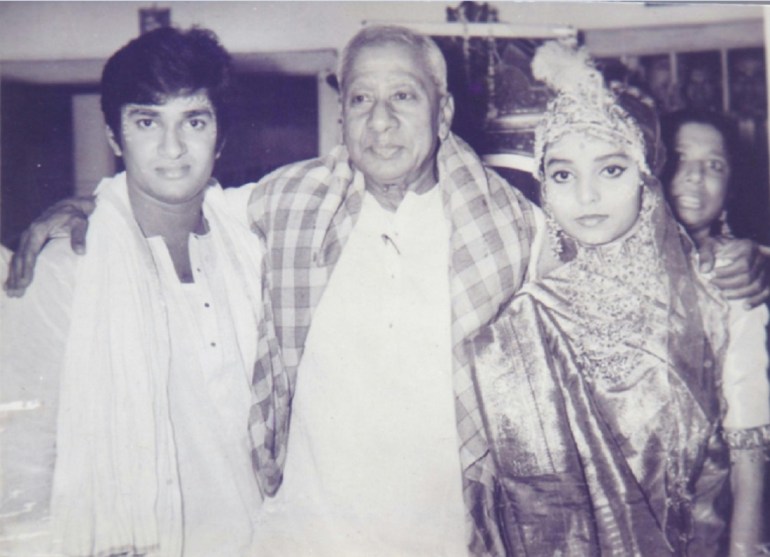 Bhabani Shaha and Shrimoti on their wedding ceremony day with RP Shaha [Photo courtesy of Rajiv Shaha]
Shrimoti, Rajiv’s mom, had tears in her eyes when the decision was delivered.
The crimes had been designed to “wipe the Hindu neighborhood” out of Mirzapur, Tangail, which lies just a little greater than 80km northwest from Narayanganj, the ICT judgement learn.
Mahbubur, who had been arrested in November 2015, died in 2020, earlier than he could possibly be hanged, however Rajiv appears glad that no less than one of many perpetrators was discovered responsible in a court docket of legislation.
Rajiv, who has three daughters and a son, ensured the three youthful kids who reside with him in Bangladesh, had been current in court docket when the judgement was handed.
“I needed them to see and perceive the historical past of this household and this nation,” Rajiv says.
For the love of his mom
RP Shaha was a local of Mirzapur, although he was born in 1896 in his maternal uncle’s dwelling in Savar, close to Dhaka. After the partition of British India, Mirzapur fell throughout the territory of East Pakistan.
However he made his fortune as a coal service provider in Kolkata (then often known as Calcutta), a metropolis that lies greater than 300km west of Shaha’s village and which fell inside India after partition.
“My grandfather was planning on shopping for the Calcutta Tram Firm and had even given an advance fee for it, however when information of partition got here alongside, he selected to purchase a enterprise near his ancestral place in what grew to become East Pakistan,” Rajiv explains.
The decisive consider him selecting Pakistan over India, Rajiv says, was his bond together with his mom, Kumudini Devi, who had died of tetanus throughout childbirth when RP Shaha was simply seven years previous.
So, as a substitute, RP Shaha acquired the jute enterprise of the Scottish agency George Henderson & Firm in Narayanganj, a hub of Bengal’s jute commerce.
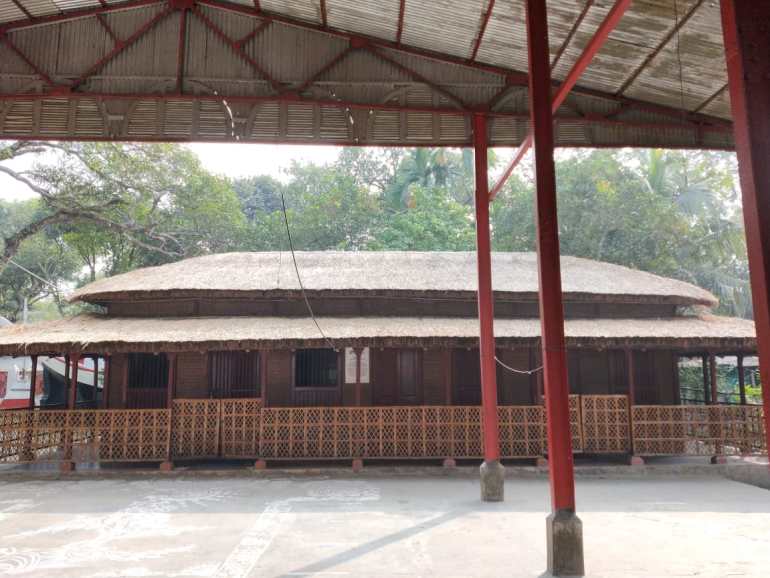 RP Shaha’s home in Mirzapur [Photo courtesy of Rajiv Shaha]
Along with his enterprise, RP Shaha established a number of charitable tasks within the identify of his mom, and in 1947 positioned all his business ventures in a charitable belief referred to as the Kumudini Welfare Belief. Earnings from the totally different enterprise ventures was funnelled to help the belief’s welfare tasks.
He based the Kumudini Hospital in 1938, and over the following years additionally established a number of faculties, faculties and nursing properties.
Going towards the present
Such was the religion RP Shaha had in his compatriots that “even when the riots of 1964 occurred my grandfather by no means considered leaving his countrymen; he swam towards the present,” Rajiv says, referring to the wave of assaults on Hindus in East Pakistan following the disappearance of a strand of hair extensively believed to have been the Prophet Muhammad’s that had been preserved on the Hazratbal shrine in Srinagar, Kashmir.
The anti-Hindu riots that broke out in response triggered an exodus of about 135,000 Bengali Hindu refugees into neighbouring India between January and April 1964.
RP Shaha, nevertheless, remained steadfast in his religion in his homeland, Rajiv says.
“‘Ami to kichu korini’ (I’ve not achieved something mistaken), my grandfather used to say,” Rajiv shares, safe within the information that “no matter he had achieved, he did for his nation [Pakistan].”
The private turns into political
However after India and Pakistan fought a conflict with one another in 1965, the ambiance in East Pakistan grew to become more and more tense, and even these in a roundabout way concerned in politics discovered themselves being portrayed as enemy brokers.
In her testimony towards Shaha’s killers, Pratibha Mutsuddy stated that after the conflict, the provincial governor of East Pakistan, Abdul Monem Khan, had begun to contemplate the Kumudini belief as an enemy.
On April 29, 1971, RP Shaha and Bhabani had been referred to as to the governor’s residence. As they had been leaving, they had been picked up by the Pakistani military and brought to a camp in Mohammadpur, a suburb of Dhaka, for additional questioning.
They had been ultimately launched on Could 5, and the household was lulled right into a false sense of safety.
“After they had been let go my members of the family had been very relieved,” Rajiv explains.
“My grandfather went to Mirzapur and reassured the opposite Hindus who had been in hiding or had already crossed the border to India that he was secure now, and that the opposite minorities additionally shouldn’t be scared.”
“My grandfather had invited the [East Pakistani] authorities individuals to Mirzapur. He needed them to see our belief’s work, and see that we’re not Indian brokers, and usually are not affiliated with any political occasion,” Rajiv says, referring to the hospital and numerous faculties and faculties run by the Kumudini Welfare Belief.
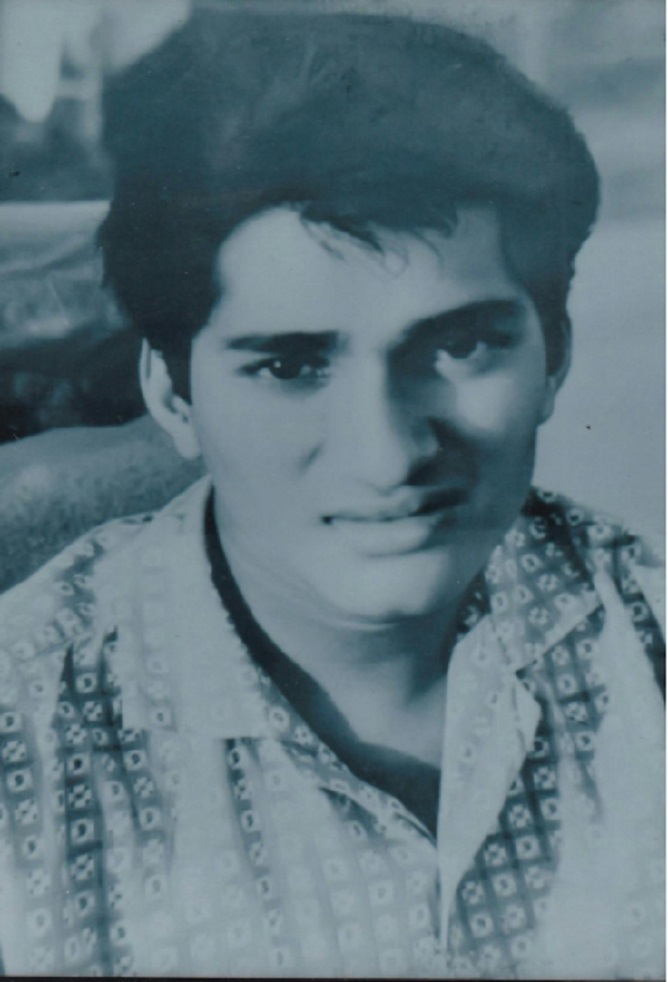 Bhabani Prasad [Photo courtesy of Rajiv Shaha]
When RP Shaha determined to make a visit to the Narayanganj headquarters from Mirzapur simply two days after they had been launched by the military, a lot of Bhabani Prasad’s associates tried to dissuade him from accompanying his father.
“My father wants me,” Bhabani informed them.
The assembly in Mirzapur between the Shaha household and authorities officers was alleged to happen on Could 8 – the day after the 2 males had been kidnapped.
The ladies take cost
Rajiv says a couple of courageous girls held the household collectively after the tragedy.
RP Shaha’s daughter, Joya Pati, stepped in to handle the household’s enterprises and continued to take action till 1999, with Rajiv on the helm since.
And when Pakistani troopers, accompanied by Razakars, went to the Bharateswari College in Could 1971 and demanded that feminine college students be handed over, Rajiv says his Boroma Protibha Mutsuddi “stepped between the troopers and the women”.
The troopers and Razakars had additionally tried to enter the Kumudini hospital earlier that day, Rajiv explains.
“Boroma and my pishis (paternal aunts) confronted off with the goons, defending my 19-year previous mom Shrimoti, me and my small cousins,” Rajiv says. They went to face the boys by themselves, guaranteeing the teenage bride remained hidden from their view.
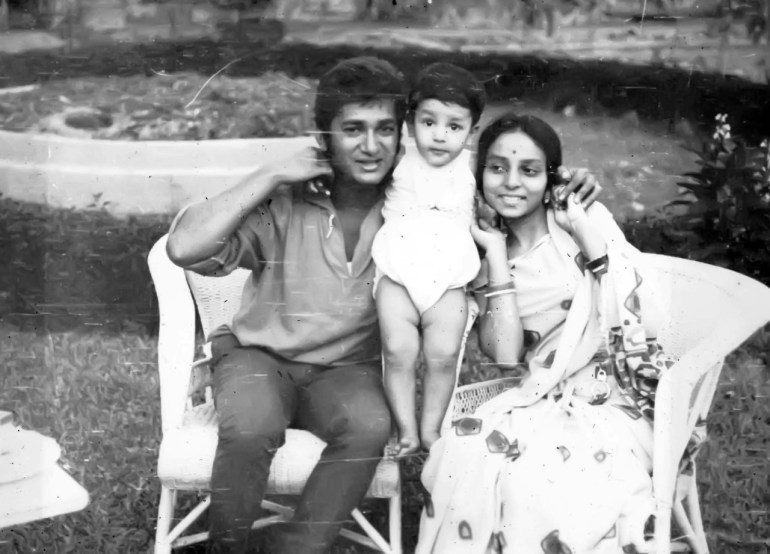 Bhabani Prasad, then 26, together with his spouse Srimati,18, and their son Rajiv, in 1970 [Photo courtesy of Rajiv Shaha]
After her husband’s disappearance, Shrimoti, who had married Bhabani Prasad in 1967, continued to decorate like a married Hindu Bengali girl for the subsequent 30 years. She would put on shakha pola (white and pink bangles) on her wrists and sindur (vermilion) in her hair parting.
Bhabani Prasad nonetheless stays a 27-year-old man to Shrimoti, Rajiv says wistfully.
“For years, my mom periodically took out her husband’s garments for airing, after which lovingly folded them again,” he provides.
It was solely in 2000 that Shrimoti wiped away the sindur and took off the shakha pola, and Rajiv carried out the ‘shraddho’ (closing rites) of his father and grandfather.
“From the time I’ve gained my senses, my mom has harassed that my grandfather and father sacrificed their lives for the Kumudini belief, for the nation,” Rajiv says, his face set in dedication. “I’ve to work for this establishment, for my nation.”
[ad_2]






Leave a Reply