
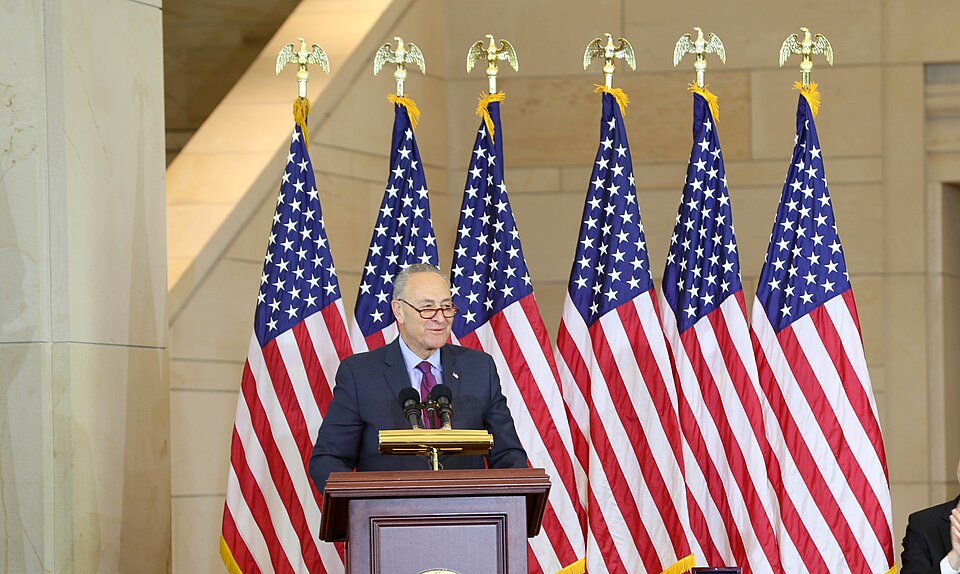
Both sides are gearing up for a tough battle ahead.
Senate Democratic Leader Chuck Schumer is preparing for a decisive political showdown with President Donald Trump as Democrats attempt to reclaim control of Congress in the November 2026 midterm elections.
Schumer believes his party has a growing opportunity to defeat Republicans and take control of the U.S. Senate. However, despite encouraging polls for Democrats, three major obstacles could prevent that outcome.
Republicans have a significant fundraising advantage, Democrats continue to struggle with unfavorable public opinion, and questions remain about whether election polls accurately reflect Republican voter support.
With control of Washington at stake, both parties are preparing for an intense final stretch before Election Day.
Schumer Makes Bold Prediction About Senate Control
Schumer recently expressed confidence that Democrats are approaching a major political breakthrough.
Speaking to reporters before the Senate adjourned for the election recess, the New York Democrat declared that his party has “the wind in our sails.”
He also suggested Democrats are close to reclaiming the Senate majority.
Schumer believes Americans are increasingly frustrated with household expenses, inflation, and the direction of the federal government.
Those economic concerns have become central issues in congressional races nationwide.
Historically, the political party controlling the White House often loses seats during midterm elections. Democrats hope that pattern will work in their favor.
However, the numbers present a serious challenge.
Republicans currently control the Senate 53-47, meaning Democrats must achieve a net gain of four seats to reclaim the majority.
That requires winning several competitive elections, including races in traditionally Republican states.
Texas, Maine, Iowa, Alaska, Ohio, and Kansas are among the states attracting significant attention.
Meanwhile, Democrats must protect vulnerable seats in Michigan and Minnesota.
For Trump, maintaining Republican control of the Senate would help preserve his administration’s ability to advance legislative priorities and confirm presidential nominees.
Trump Predicts Republicans Will Defy Expectations
Despite polls suggesting Democrats could make substantial gains, Trump believes Republicans are positioned to deliver an Election Day surprise.
During a recent rally in Ohio, the president expressed confidence that Democratic leaders and political analysts are overlooking Republican support.
Trump’s prediction comes as questions about polling accuracy are receiving renewed attention.
Political analyst Nate Silver recently pointed out that election surveys underestimated Trump and other Republican candidates in 2016 and 2020.
A smaller polling error also occurred in 2024.
However, Silver noted that polling during the 2018 and 2022 midterm elections was generally more accurate.
That makes predicting November’s results particularly difficult.
Recent Democratic primary elections have also produced unexpected outcomes, including contests in Michigan, Minnesota, Florida, and Wisconsin.
Those results have raised questions about how accurately surveys measure voter preferences.
If Republican voters turn out in greater numbers than anticipated, even a small polling error could change the outcome of several closely contested Senate races.
Still, past polling mistakes do not guarantee similar results in 2026.
Democrats Face Growing Concerns About Party’s Image
Another potential obstacle for Schumer is the Democratic Party’s standing with American voters.
Although Trump’s approval ratings have weakened, Democrats are facing considerable dissatisfaction themselves.
A recent Fox News national poll found that 44% of respondents viewed the Democratic Party favorably, while 55% expressed unfavorable opinions.
A separate Wall Street Journal survey reported even lower Democratic favorability, with 38% holding a positive opinion and 58% viewing the party negatively.
These findings highlight an important challenge.
Voters who are unhappy with Republicans may not automatically support Democrats.
Former Transportation Secretary Pete Buttigieg recently acknowledged that problem, arguing that Democratic candidates must do more to explain their priorities and earn public trust.
The party’s internal divisions could further complicate its election strategy.
In several states, progressive candidates have defeated more moderate opponents during Democratic primaries.
Those victories have provided Republicans with opportunities to scrutinize their opponents’ positions on government spending, immigration, public safety, and other major issues.
In Michigan, Minnesota, and Florida, Democrats nominated Abdul El-Sayed, Peggy Flanagan, and Angie Nixon, respectively.
Republicans are attempting to make those candidates’ policy positions central issues in the general election.
Meanwhile, in Texas, Democratic Senate nominee James Talarico is facing renewed scrutiny over previous public statements.
A Fox News survey found that 53% of Texas respondents were extremely or very concerned that Talarico was too liberal.
Democrats are pursuing a similar strategy against Republicans.
The same survey found that 51% of respondents expressed significant concern that Republican Senate nominee Ken Paxton was too closely aligned with Trump.
These competing concerns demonstrate how candidate reputations could influence the election.
Republicans Hold Major Financial Advantage
Schumer’s party also faces another significant obstacle: Republican campaign spending.
Republican-aligned organizations have invested substantial amounts of money in competitive Senate contests.
Groups associated with Trump, including MAGA Inc., are helping finance Republican election efforts alongside other political committees and major donors.
According to advertising tracking firm AdImpact, Republicans are outspending Democrats in several closely watched states.
In Ohio, Republican-aligned spending exceeds Democratic spending by approximately $70 million.
The GOP also holds advantages approaching $30 million in both Maine and Texas.
Meanwhile, Republicans have an estimated $25 million advantage in Michigan, where the party hopes to capture a Democratic-held Senate seat.
Republican organizations are also spending heavily in New Hampshire, where candidates are competing to replace retiring Democratic Senator Jeanne Shaheen.
This financial advantage allows Republican candidates and supporting organizations to purchase additional political advertising, reach undecided voters, and respond to criticism during the closing weeks.
However, campaign spending alone does not determine election outcomes.
Democrats believe grassroots organizing and voter enthusiasm could help offset Republican spending.
Longtime New Hampshire Democratic Party Chairman Ray Buckley recently acknowledged that Republicans are dominating television advertising in his state.
Nevertheless, he argued that Democrats remain competitive through direct voter outreach and door-to-door campaigning.
Whether that strategy succeeds will depend heavily on turnout in November.
Why This Election Matters for Trump’s Presidency
The outcome of the midterm elections could significantly influence the final two years of Trump’s second term.
Republicans currently control the White House and both chambers of Congress.
That arrangement gives the president an opportunity to work with Republican lawmakers on major legislative priorities.
However, a Democratic Senate majority would change the balance of power in Washington.
Democrats would gain control of Senate committees, influence over legislative negotiations, and greater authority over the confirmation process for presidential nominees.
A change in congressional leadership could also affect debates over federal spending, immigration enforcement, energy policy, and government oversight.
For Americans concerned about retirement security, Social Security, Medicare, taxes, and the cost of living, the election’s consequences could extend well beyond partisan politics.
Economic concerns are already playing a major role in the campaign.
Higher grocery bills, gasoline prices, and household expenses remain important issues for voters.
The ongoing conflict involving Iran has also contributed to uncertainty surrounding energy costs.
Democrats are attempting to make affordability a central argument against Republican leadership.
Republicans, meanwhile, are emphasizing their policy priorities while challenging Democratic candidates’ proposals.
The competing messages will be tested when voters head to the polls.
Schumer’s Senate Strategy Faces Final Test
With November approaching, Schumer is projecting confidence that Democrats can achieve a major victory.
But the race for Senate control remains uncertain.
Democrats appear competitive in several states that previously favored Republicans, while the GOP continues to benefit from substantial campaign resources.
Questions about polling accuracy, voter enthusiasm, and the Democratic Party’s public image could all influence the outcome.
Trump believes Republicans will perform better than political observers expect.
Schumer is betting that voter dissatisfaction with the current administration will help Democrats reclaim power.
Ultimately, the November 3 midterm elections will determine whether Schumer succeeds in his effort to regain the Senate majority or whether Trump and Republicans retain control of the chamber.
For both parties, the results could shape American politics through the remainder of Trump’s presidency.







Leave a Reply