
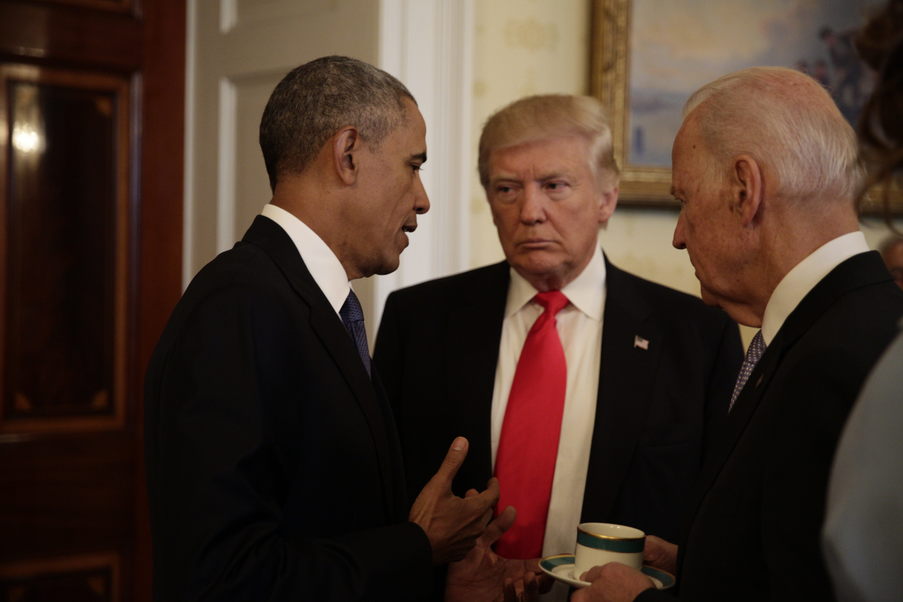
Trump isn’t going to let the mainstream media shape the narrative.
President Donald Trump unleashed a fresh round of criticism against former President Joe Biden on Monday, placing responsibility for higher prices on his predecessor while defending his own handling of the economy and the escalating conflict with Iran.
Trump’s comments were part of a series of social media posts covering some of the biggest issues facing Americans, including inflation, oil prices, military readiness, the Strait of Hormuz and the rapid expansion of artificial intelligence.
But his message about Biden was particularly direct.
“I hope everyone realizes that price increases throughout America were caused by Sleepy Joe Biden and the Biden Administration, not by ‘TRUMP,’” Trump wrote on Truth Social.
Trump went on to argue that Americans should remember how dramatically prices increased during the Biden years when evaluating today’s economy.
Trump Blames Biden for Higher Prices
The president’s argument comes as the cost of living remains a major concern for millions of American families.
Inflation surged during Biden’s presidency, particularly in the years following the COVID-19 pandemic. Americans experienced substantial increases in the cost of groceries, housing, vehicles, insurance and other everyday expenses.
Trump is now attempting to draw a clear distinction between his economic record and Biden’s.
However, presidents do not have complete control over inflation. Consumer prices can be influenced by numerous factors, including federal spending, interest rates, supply-chain disruptions, energy costs, global conflicts and consumer demand.
Trump nevertheless made clear that he believes the previous administration deserves much of the responsibility for the price increases Americans have experienced.
Trump Makes Major Prediction About Oil
Energy was another major part of Trump’s message.
The president argued that oil had previously reached higher levels during Biden’s presidency and predicted that current prices would fall substantially once the conflict with Iran ends.
Trump said oil would “drop like a rock” following the conclusion of the conflict.
That would certainly be welcome news for Americans watching gasoline and transportation costs.
For now, however, oil remains expensive.
Brent crude settled at $105.68 per barrel Monday as escalating tensions in the Middle East continued to create concerns about global energy supplies.
Those prices have been driven in part by disruptions surrounding the Strait of Hormuz and attacks on energy infrastructure in the region.
The situation demonstrates just how quickly international conflicts can find their way into American household budgets.
When oil becomes more expensive, the consequences can extend well beyond the gas station. Higher transportation and production costs can eventually affect the prices consumers pay for a wide range of goods.
Trump Wants Other Countries to Pay
Trump also delivered a strong message to foreign governments benefiting from continued oil shipments through the Strait of Hormuz.
The president argued that countries benefiting from American efforts to protect the strategically important shipping route should help cover the cost.
Trump said nations that provided little assistance should reimburse the United States once the conflict is over.
His comments touch on a longstanding debate in American politics: how much the United States should spend protecting international trade and security interests that also benefit other wealthy nations.
The Strait of Hormuz is especially important because it serves as a critical route for global energy shipments. Serious disruptions there can send oil prices higher around the world.
Trump’s position appears to be that American taxpayers should not be expected to carry a disproportionate financial burden while other countries receive substantial economic benefits.
Trump Says Iran Wants an Agreement
Trump also addressed the possibility of negotiations with Iran.
The president characterized Iran as a struggling nation and claimed Tehran wants to reach an agreement with the United States.
Trump has repeatedly predicted that the conflict will not continue indefinitely and has suggested that an eventual agreement could help relieve pressure on global energy markets.
Whether negotiations ultimately produce an agreement remains uncertain.
For American consumers, however, the stakes extend far beyond foreign policy.
A reduction in Middle East tensions could ease concerns about oil supplies and potentially put downward pressure on energy prices. Continued escalation could have the opposite effect.
Questions Grow Over America’s Weapons Supply
Trump also used Monday’s posts to address concerns about America’s military stockpiles.
The president said he had received a report indicating that the United States is producing advanced weapons at an extraordinary pace.
According to Trump, American defense factories are operating around the clock while additional manufacturing facilities are being constructed.
He specifically highlighted Patriot air-defense systems, THAAD systems, Tomahawk missiles and other missile platforms.
The comments come amid scrutiny of America’s military inventories following extensive operations overseas.
A government watchdog reported Monday that the conflict with Iran has placed significant pressure on U.S. weapons stockpiles and highlighted production bottlenecks that could complicate efforts to replenish certain munitions.
Trump’s statements therefore offer a considerably more optimistic assessment of American weapons production.
For taxpayers and national-security officials, the central question is whether manufacturers can replenish critical weapons quickly enough to maintain America’s military readiness while continuing to meet current commitments.
Trump Defends America’s AI Boom
Trump wasn’t finished.
The president also strongly defended America’s rapidly growing artificial intelligence industry and the construction of AI data centers around the country.
Trump argued that the explosion in data-center development is happening because the United States has established a significant advantage over international competitors.
“Don’t kill the Golden Goose!” Trump warned.
The rapid expansion of AI infrastructure has become an increasingly important economic and political issue.
Supporters say the projects can bring billions of dollars in investment, construction activity and technology jobs into American communities.
Critics have raised concerns about electricity consumption, water usage, utility costs and the enormous infrastructure requirements associated with large data centers.
Trump has made his position increasingly clear: he believes maintaining America’s advantage in artificial intelligence is vital to the country’s economic and national-security interests.
A Bigger Economic Fight Is Taking Shape
Trump’s flurry of posts ultimately connects several issues that could have a direct impact on American households: inflation, gasoline prices, military spending, international security and technological competition.
His sharpest political message was reserved for Biden.
Trump wants Americans frustrated by today’s prices to remember when much of the inflation occurred and to place responsibility on the previous administration.
Biden’s critics can point to the major increase in consumer prices that occurred during his presidency. At the same time, inflation is influenced by factors extending beyond any one president, including monetary policy, global energy markets, wars, supply constraints and economic conditions.
That distinction is important because the battle over the economy is ultimately about more than political credit.
For Americans trying to pay for groceries, gasoline, housing and other necessities, the more immediate question is whether prices will finally become easier to manage.
Trump is betting that his economic and energy policies will deliver that relief—and he clearly wants Americans to remember who he believes created the problem in the first place.


Leave a Reply