
[ad_1]
Taipei, Taiwan – Airbnb’s “group” part reads like a who’s who of progressive causes in america.
The short-term rental big has donated to Black Lives Matter, supplied housing to Afghan refugees, and boasts prime marks on a company equality index as an inclusive employer.
The highest characteristic on its English-language information web page is an article, dated February 2, about an Airbnb rental in Los Angeles hosted by American actress Issa Rae, who is understood for talking out towards racial injustice and inequality.
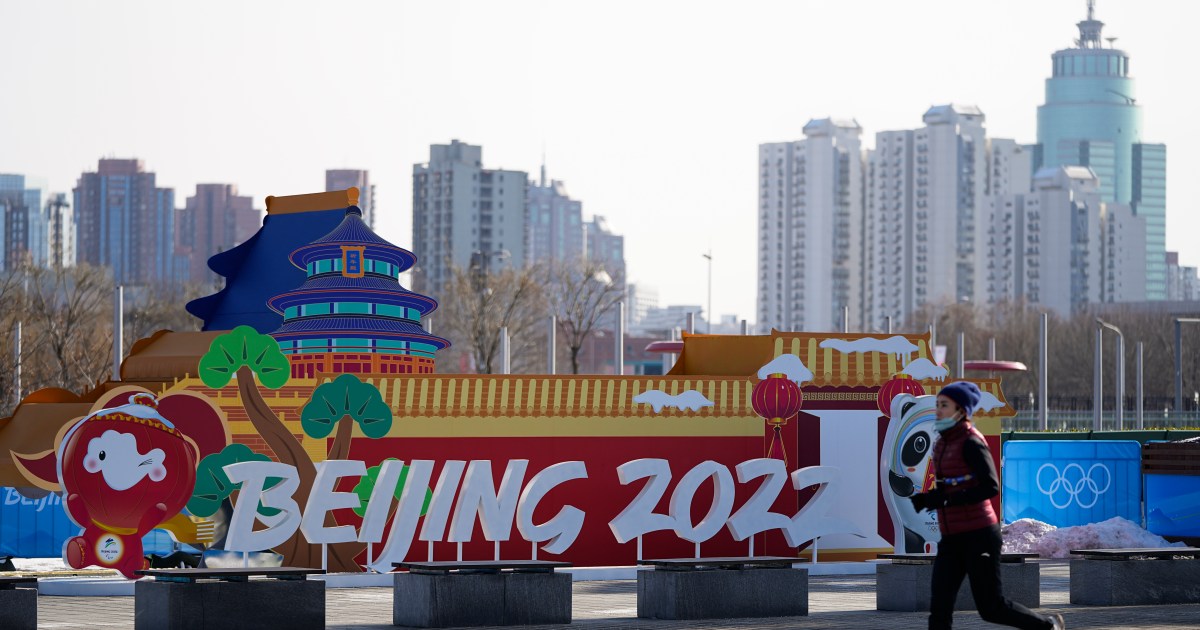
Lacking from Airbnb’s web site, Twitter or Instagram is any point out of the corporate’s official sponsorship of the 2022 Beijing Winter Olympics, which have been underway since Friday.
Airbnb is just not the one official Olympics sponsor that seems to be downplaying its position on the Winter video games – at the very least in English – following a diplomatic boycott by international locations together with the US, the UK, Canada, Australia, Denmark, Estonia and Lithuania over human rights abuses towards ethnic minority Muslims in China’s Xinjiang area and pro-democracy figures in Hong Kong.
The social media accounts of sponsors corresponding to Snickers and Bridgestone, the Japanese auto elements firm, have chosen to focus on the Tremendous Bowl over the Olympics, whereas Black Historical past Month ranks greater on the Instagram account of US multinational Procter and Gamble.
 Sponsors of the Winter Olympic Video games corresponding to Airbnb have taken a vocal stance on social justice points in america [File: Issei Kato/Reuters]
Multinational companies’ tepid affiliation with the Video games highlights the awkward place that corporations can face when dabbling in social justice points – a pattern dubbed “woke capitalism” – whose attraction to customers varies extensively by geography.
Many official sponsors look like working “bifurcated campaigns” that see them working one marketing campaign in China across the Olympics and totally different campaigns elsewhere, in line with Rick Burton, who served as chief advertising officer for the US Olympic Committee on the 2008 Beijing Summer season Olympic Video games.
“Are sponsors utilizing Olympic imagery worldwide? And are they utilizing it as aggressively as they’ve previously? And I feel the quick reply is not any, they’re not,” Burton instructed Al Jazeera, citing a number of causes starting from the COVID-19 pandemic to the truth that the Tokyo Summer season Olympics and Paralympics ended simply six months in the past.
Burton mentioned that regardless of the controversy surrounding the Winter Olympics, manufacturers doubtless knew what they had been signing up for from the beginning.
“In Rio de Janeiro, the displacement of the poor and the air pollution and the usage of funds to construct sporting services when there was poverty triggered folks to need sponsors to protest or boycott,” he mentioned. “In Sochi, Russia, the identical existed on the subject of homosexual rights, and it now exists in China, primarily based on human rights reporting or human rights beliefs.”
American firms, specifically, are dealing with a problem past the diplomatic boycott because the Winter Olympics coincides with the Tremendous Bowl — crucial occasion in American soccer — for the primary time ever. Among the many massive names, solely Intel and Visa have outstanding Olympics branding on their web sites and social media accounts.
French and German multinationals Atos and Allianz have at the very least some Instagram content material, though nothing on Twitter, whereas Swiss watchmaker Omega hyperlinks to a devoted Olympics web page on its social media accounts. Most sponsors have an Instagram story that the person has to click on on to see Olympic content material, though it’s not a part of the overall feed.
Allianz instructed Al Jazeera in an announcement that the corporate had made a long-term dedication to sponsor the Olympics “which matches far past the present Winter Video games,” whereas Atos mentioned in an announcement that regardless of being an Olympic sponsor since 2001, it had not marketed at Asian video games together with PyeongChang 2018, Tokyo 2021, and now Beijing 2022.
Swiss watchmaker Omega, which describes itself because the official “timekeeper” of the Olympics as an alternative of a sponsor, hyperlinks to a devoted web page for the Video games on its social media accounts.
Airbnb, Snickers, Bridgestone and Procter and Gamble didn’t reply to requests for remark.
Previous controversies
Regardless of the diplomatic boycott, the Beijing Winter Olympics are removed from the primary version of the video games to court docket controversy. Most Olympics have drawn some type of protest, together with the 2014 Sochi Winter Olympics, which was held months after Russian President Vladimir Putin signed a legislation prohibiting “homosexual propaganda.”
The 1972 Munich and 1996 Atlanta Summer season Olympics had been marred by violence. The Summer season Olympics in 1936, 1976, 1980 and 1984 all attracted main boycotts as a result of hyperlinks with Nazi Germany, South Africa’s apartheid regime, and the Chilly Warfare.
One main distinction with the Beijing Olympics is the current rise in identification politics and social justice activism within the West and the way manufacturers and companies are anticipated to reply, mentioned Burton, the previous US Olympic Committee official.
“The large distinction is how social consciousness has modified even since Sochi in 2014, when folks had been involved about Russia’s LGBTQ document, and with Black Lives Matter campaigns and large protests actions world wide, these points are much more mainstream,” Burton mentioned, including that social consciousness seems totally different from nation to nation.
Differing perceptions and values can put Western corporations at odds with Chinese language customers, who might worth sustainability and environmentalism however don’t wish to see manufacturers criticising China on points like Xinjiang, Hong Kong or Tibet, mentioned Zak Dychtwald, the founder and CEO of Younger China Group, a think-tank targeted on China’s rising identification.
Because of social media, the gap between China and the remainder of the world has additionally narrowed, which implies customers are more and more fast to react as effectively, Dychtwald mentioned.
“Whereas a decade in the past, actually pre-WeChat, there have been better obstacles separating these two info ecosystems, these obstacles have turn into way more porous and so there are way more public slip-ups,” Dychtwald instructed Al Jazeera, referring to China’s hottest messaging app.
“I name them slip-ups as a result of these are firms which can be conscious of the ecosystem they’re dealing with in China, not simply the regulatory ecosystem however potential client backlash – particularly these final three years.”
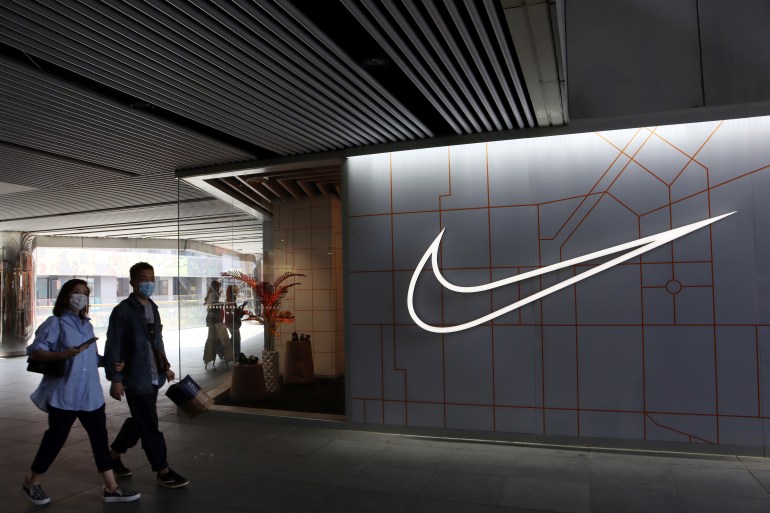 Western manufacturers corresponding to Nike have come below fireplace from Chinese language customers for talking out on human rights points in China [File: Florence Lo/Reuters]
Manufacturers may take heed to public relations disasters and boycotts in China confronted by Nike, H&M and Intel after they pledged to not supply supplies from Xinjiang as a result of allegations of pressured labour within the area.
“You don’t wish to put your self ready of claiming one thing about Chinese language manufacturing, after which be put ready the place you might need to retract it,” Veronica Bates Kassatly, a UK-based unbiased analyst within the sustainable attire sector, instructed Al Jazeera.
“They’re fed up with the Western world humiliating them and so they’re not going to place up with it any extra,” Kassatly mentioned, referring to Chinese language customers. “They now have the financial muscle and so they don’t must.”
This places many multinational manufacturers in a troublesome place and will reward silence at occasions just like the Olympics. Whereas firms like Apple, Airbnb and the NBA might hail from the US, they now see China as one in all their most necessary markets.
The Olympics, Dychtwald mentioned, has simply supplied the chance for customers outdoors of China to see that shift.
“They name it ‘woke capital’ within the US, there’s a way that customers can change how firms can behave, and in China, that’s very a lot true [as well],” he mentioned. “I feel what makes lots of people uncomfortable is that what plenty of customers [in China] are asking for is inconsistent with the ethical commonplace that we set within the US and in Western international locations.”
[ad_2]



Leave a Reply