
Here’s what happened.
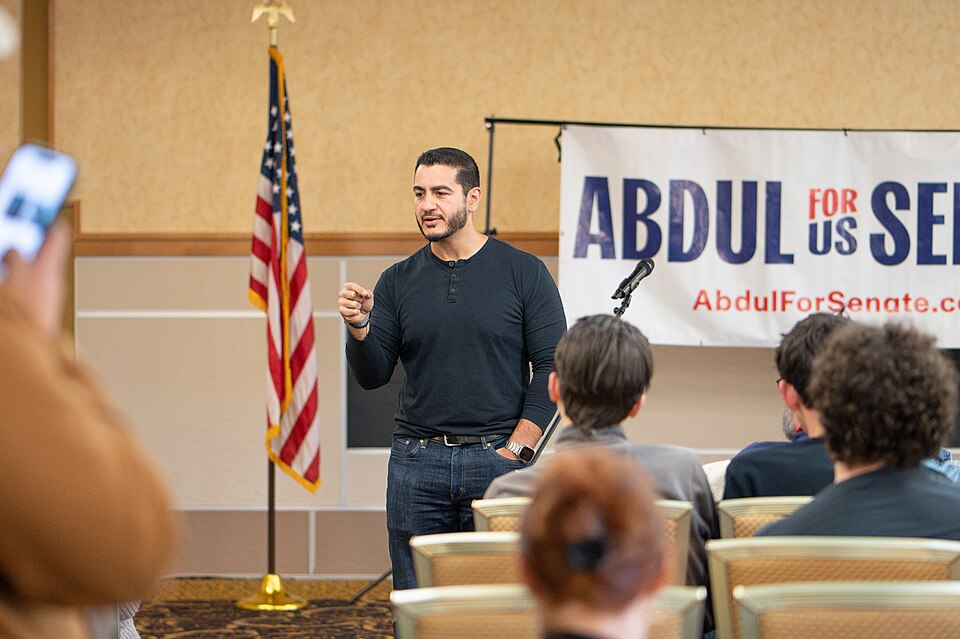
Michigan Democratic Senate candidate Abdul El-Sayed is facing mounting criticism after remarks about Second Lady Usha Vance triggered a backlash from Republicans and Indian-American leaders in one of the nation’s most closely watched battleground states.
The controversy comes at a difficult moment for El-Sayed as he battles former Republican Rep. Mike Rogers in a highly competitive Michigan Senate race.
Republicans believe El-Sayed’s comments crossed a political line by bringing Vice President JD Vance’s wife into attacks directed at her husband. They are now seeking to turn the controversy into a larger campaign issue involving civility, family and the boundaries of political debate.
The dispute could prove particularly important in Michigan, where women make up a powerful voting bloc and the state’s Indian-American community could play a role in a close election.
El-Sayed’s Comment About Usha Vance Draws Backlash
The latest controversy began with a social media post involving JD Vance’s late grandfather, whom the vice president called “Papaw.”
“So do we think JD is taking Usha with him back in time to meet Papaw, or no …” El-Sayed wrote on X.
Republicans quickly criticized the remark, questioning why Usha Vance was being brought into a political dispute when she is not a candidate for office.
One unnamed GOP insider quoted by the New York Post accused El-Sayed of going after women rather than confronting his political opponents directly.
Michigan Republican Party co-chair Sunny Reddy similarly argued that politicians’ spouses and children should remain outside the political crossfire.
“We may have differences. We attack each other. But going to the family and the kids is a disaster,” Reddy told the Post. “They are not the one running.”
Republicans and Indian-American leaders have called on El-Sayed to apologize.
JD Vance Heads To Michigan As Controversy Grows
The timing could make the dispute even more politically significant.
Vice President JD Vance is scheduled to travel to Michigan on Monday to campaign in the state’s 10th Congressional District near Detroit.
Republican officials expect the controversy involving Usha Vance to receive additional attention during his visit.
Reddy predicted that Vance would respond forcefully and suggested El-Sayed could face additional criticism from voters.
The Senate contest is already extremely close. According to the RealClearPolitics polling average cited in the original report, El-Sayed’s advantage over Rogers is less than one percentage point.
In a race decided by such narrow margins, even modest movement among important groups of voters could make a difference.
Republicans See Opportunity With Women Voters
Republicans believe the comments could prove particularly damaging among Michigan women.
Census Bureau figures cited in the report show that approximately 69% of Michigan women participated in the election measured, putting female voter participation in the state roughly 10 percentage points above the national average.
That makes women — particularly middle-aged and suburban voters — an important constituency for both parties.
Republicans are attempting to frame the controversy around a broader question of political conduct: Should the spouse of an elected official become a target simply because of whom he or she married?
Reddy believes many Michigan voters will conclude that family members should remain off limits.
He said state Republicans are already working to incorporate El-Sayed’s remarks into campaign advertising.
Michigan’s Indian-American Community Enters The Debate
The controversy could also receive attention among Michigan’s Indian-American voters.
Usha Vance, the daughter of Indian immigrants, has become one of the country’s most prominent Indian-American public figures since her husband became vice president.
Michigan is home to a significant Indian-American population, making any controversy involving the second lady potentially noteworthy in a close statewide election.
Republicans believe the episode gives them an opportunity to appeal to South Asian voters who may otherwise lean Democratic.
Whether the controversy actually changes voting behavior remains uncertain. But with the Senate contest effectively a toss-up, both parties have reason to pay close attention to relatively small constituencies capable of influencing the final result.
Earlier El-Sayed Remark About Usha Resurfaces
El-Sayed is also facing renewed scrutiny over an earlier comment involving the second lady.
During an April appearance on “The Allen Analysis Show” podcast, El-Sayed joked about Usha Vance’s marriage to the vice president and referenced her pregnancy.
Critics argued that the comments were unnecessarily personal and had little connection to legitimate policy disagreements with JD Vance.
The resurfacing of that interview has allowed Republicans to argue that the latest controversy was not an isolated incident.
Reddy specifically objected to El-Sayed bringing Usha Vance’s pregnancy into the political discussion.
For Republicans, the previous remarks reinforce their argument that the Senate candidate has repeatedly crossed a line between criticizing an opponent and targeting the opponent’s family.
Usha Vance Turns The Attack Into A Family Story
Usha Vance herself responded much differently.
In an interview with Fox News, the second lady said she “kind of laughed” when she first learned about the criticism involving her husband’s grandfather.
She then turned the subject toward the Vance family’s relationship with her.
Usha described JD Vance’s children as “incredibly loving” toward her and said she believed her husband’s late grandfather would have welcomed her in much the same way.
Her response transformed what had been intended as a political jab into a discussion about family.
JD Vance has frequently spoken publicly about the grandparents who helped raise him.
Their influence became nationally known through his bestselling memoir, “Hillbilly Elegy,” in which Vance wrote extensively about his grandparents and his upbringing in Ohio.
Vance has previously expressed regret that his grandparents never had the opportunity to meet Usha.
El-Sayed Faces Questions Over Hasan Piker
The Usha Vance controversy is not the only political challenge confronting El-Sayed.
The Democratic candidate has also faced questions over his association with political commentator Hasan Piker, whose past statements have generated significant controversy.
Piker has faced accusations of antisemitism from critics and previously drew widespread condemnation for saying that “America deserved 9/11.”
The association has become an issue in the Michigan campaign, with El-Sayed’s critics demanding that he clearly distance himself from Piker’s most controversial statements.
El-Sayed appeared Thursday in Ann Arbor with Democratic Reps. Jamie Raskin of Maryland and Debbie Dingell of Michigan.
Dingell urged reporters and voters to move beyond the Piker controversy.
“Don’t any reporter ask me again about Hasan Piker,” Dingell told supporters. “It’s not what November is about.”
But prominent Democratic strategist James Carville has been unwilling to dismiss the issue.
Carville said on his “Politics War Room” podcast that he found El-Sayed “really, really troubling” and argued that the Senate candidate should specifically explain which Piker statements he rejects.
Carville said some of Piker’s comments made him deeply uncomfortable.
The criticism is notable because it demonstrates that concerns about El-Sayed are not coming exclusively from Republicans.
Michigan Senate Race Could Come Down To The Wire
All of this is unfolding against the backdrop of a Michigan Senate contest that could have national consequences.
El-Sayed and Rogers are fighting for voters in one of America’s most important political battlegrounds, where relatively small changes in turnout can determine statewide elections.
Republicans now see the Usha Vance controversy as an opportunity to raise questions about El-Sayed’s judgment while appealing to women, Indian-Americans and voters frustrated with increasingly personal political attacks.
Democrats, meanwhile, have an incentive to move the campaign back toward issues they believe will matter more when voters cast their ballots.
El-Sayed’s challenge is preventing a series of controversial comments and associations from defining his candidacy during the critical final stretch.
The ultimate political impact remains uncertain. Campaign controversies can attract enormous attention without significantly changing how voters behave.
But in a Senate race where the candidates are separated by less than a percentage point, neither side can afford to ignore an issue capable of moving even a small number of voters.
And with JD Vance heading to Michigan, Republicans preparing campaign advertising and Indian-American leaders demanding an apology, the controversy surrounding El-Sayed’s remarks about Usha Vance appears unlikely to disappear anytime soon.



Leave a Reply