
[ad_1]
New Delhi, India – Fb allowed a lot of ghost and surrogate advertisers to secretly fund the Bharatiya Janata Get together’s (BJP) election campaigns in India and increase the governing occasion’s visibility, in accordance with an evaluation of ads positioned on the social media platform throughout 22 months and 10 elections.
Advertisers both hid their identities or their connections with the BJP, whilst they paid tens of thousands and thousands of rupees to Fb, principally to point out ads that promoted India’s ruling occasion and its leaders. These ghost and surrogate advertisers acquired virtually as many views because the ads formally positioned by India’s governing occasion, doubling its visibility with out the occasion having to take duty for the content material or the expenditure associated to their ads.
The Reporters’ Collective (TRC), a non-profit media organisation based mostly in India, and advert.watch, a analysis venture learning political ads on social media, mapped all of the advertisers which have spent greater than 500,000 rupees ($6,529) on political ads on Fb between February 2019 and November 2020, utilizing the Advert Library’s Utility Programming Interface (API), Meta’s “transparency” instrument that enables entry to political promoting information throughout its platforms. Aside from the parliamentary elections, this era noticed meeting elections in a number of states, together with Delhi, Odisha, Bihar, Haryana and Maharashtra.
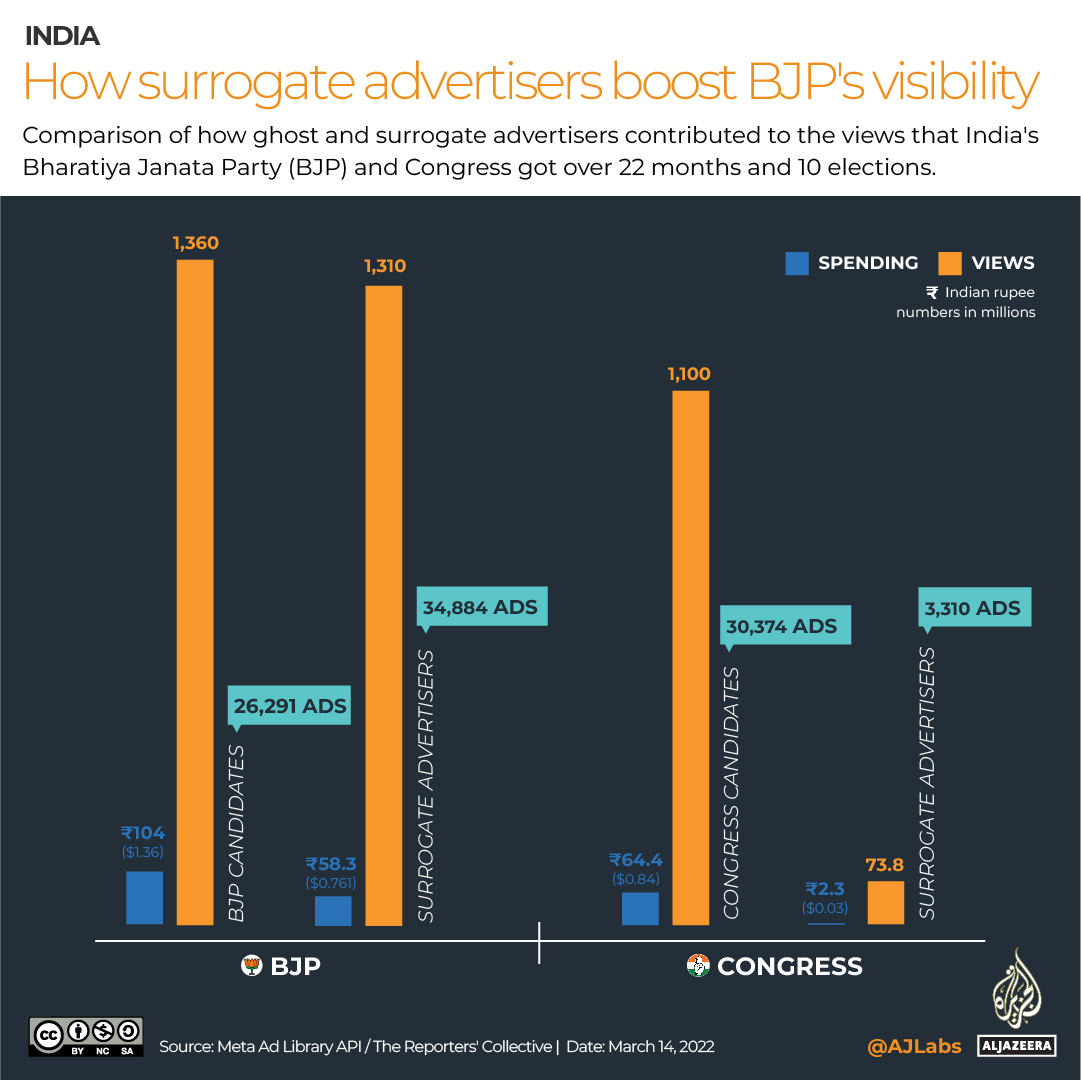
TRC discovered the BJP and its candidates formally positioned 26,291 ads by spending not less than 104 million rupees ($1.36m), for which they acquired greater than 1.36 billion views on Fb. That aside, not less than 23 ghost and surrogate advertisers additionally positioned 34,884 ads for which they paid Fb greater than 58.3 million rupees ($761,246), principally to advertise the BJP or denigrate its opposition, with out disclosing their actual identities or their affiliation with the occasion. These ads acquired greater than a whopping 1.31 billion views.
Compared, the contribution of ghost and surrogate advertisers for Congress, the BJP’s essential opponent, was minuscule. Congress and its candidates formally positioned 30,374 ads by paying not less than 64.4 million rupees ($840,897), which acquired them greater than 1.1 billion views. Solely two surrogate advertisers (amongst those that spent greater than 500,000 rupees – $6,529 – on ads) spent 2.3 million rupees ($30,032) on 3,130 ads on pro-Congress pages with out disclosing affiliation with the occasion. These ads acquired greater than 73.8 million views. One other web page spent 4.95 million rupees ($64,634) on 1,364 ads in campaigns towards Modi, principally in West Bengal elections final 12 months in April, which acquired greater than 62.4 million views.
One purpose Congress had such few surrogate advertisers is probably going as a result of Fb carried out an enormous crackdown on its proxy campaigners proper earlier than the 2019 parliamentary elections. On the time, Fb mentioned it eliminated 687 pages and accounts that have been linked with Congress’s IT Cell and that promoted the occasion however hid their identities. Throughout that crackdown, just one web page and 14 accounts that promoted the BJP whereas concealing their identities and associations with the occasion have been eliminated.
TRC’s year-long investigation now signifies that whereas the crackdown might need prevented Congress from unduly influencing Fb customers, it didn’t prolong to the BJP as a lot of surrogate advertisers have continued to advertise India’s governing occasion.
Whereas a few of this has been reported prior to now, the general scale of surrogate promoting and its impression haven’t been assessed or reported earlier than.
Indian regulation prohibits surrogate political promoting in print and digital media to carry political events and candidates accountable for the content material they put out in these wide-reaching mediums, to stop the influx of funds from unknown sources and to make sure that election expenditures for candidates keep inside the obligatory authorized limits.
However, as we reported in Half 1 of this collection, the Election Fee of India has not prolonged these guidelines to social media regardless of being conscious of this hole. Fb pushed business physique the Web and Cellular Affiliation of India (IAMAI) to foyer the ECI to not impose stiff laws on social media platforms throughout elections, paperwork leaked by Fb whistleblower Frances Haugen not too long ago confirmed.
This, in flip, allowed surrogate promoting to thrive on Fb, benefitting the BJP.
In response to a listing of detailed questions over e mail, together with on political ads by a number of surrogate advertisers listed on this story, Meta mentioned: “We apply our insurance policies uniformly with out regard to anybody’s political positions or occasion affiliations. The choices round integrity work or content material escalations can not and usually are not made unilaterally by only one particular person; reasonably, they’re inclusive of various views from across the firm, a course of that’s vital to creating certain we think about, perceive and account for each native and international contexts.”
It added, “Our enforcement towards Coordinated Inauthentic Behaviour was by no means stopped and continues even after the April 2019 elections.” Meta’s full response might be learn right here (PDF).
BJP’s chief spokesman Anil Baluni and IT and social media head Amit Malviya didn’t reply to TRC’s questions regardless of repeated reminders. ECI too didn’t reply to a listing of queries.
BJP’s surrogate ecosystem
After it confronted backlash within the US for allegedly influencing elections, Fb rolled out a coverage in 2018 to confirm the id and handle of people that place political ads on its platforms. It additionally asks all such advertisers to self-declare who’s paying for the ads. Claiming transparency, Fb began carrying these funding disclosures together with the political advertisements. This mechanism, nevertheless, doesn’t cease advertisers from campaigning on behalf of the political candidates whereas hiding their associations with them.
Many advertisers listed web sites that both didn’t work or, if it did, had a fundamental web page with no data on possession or contact particulars.
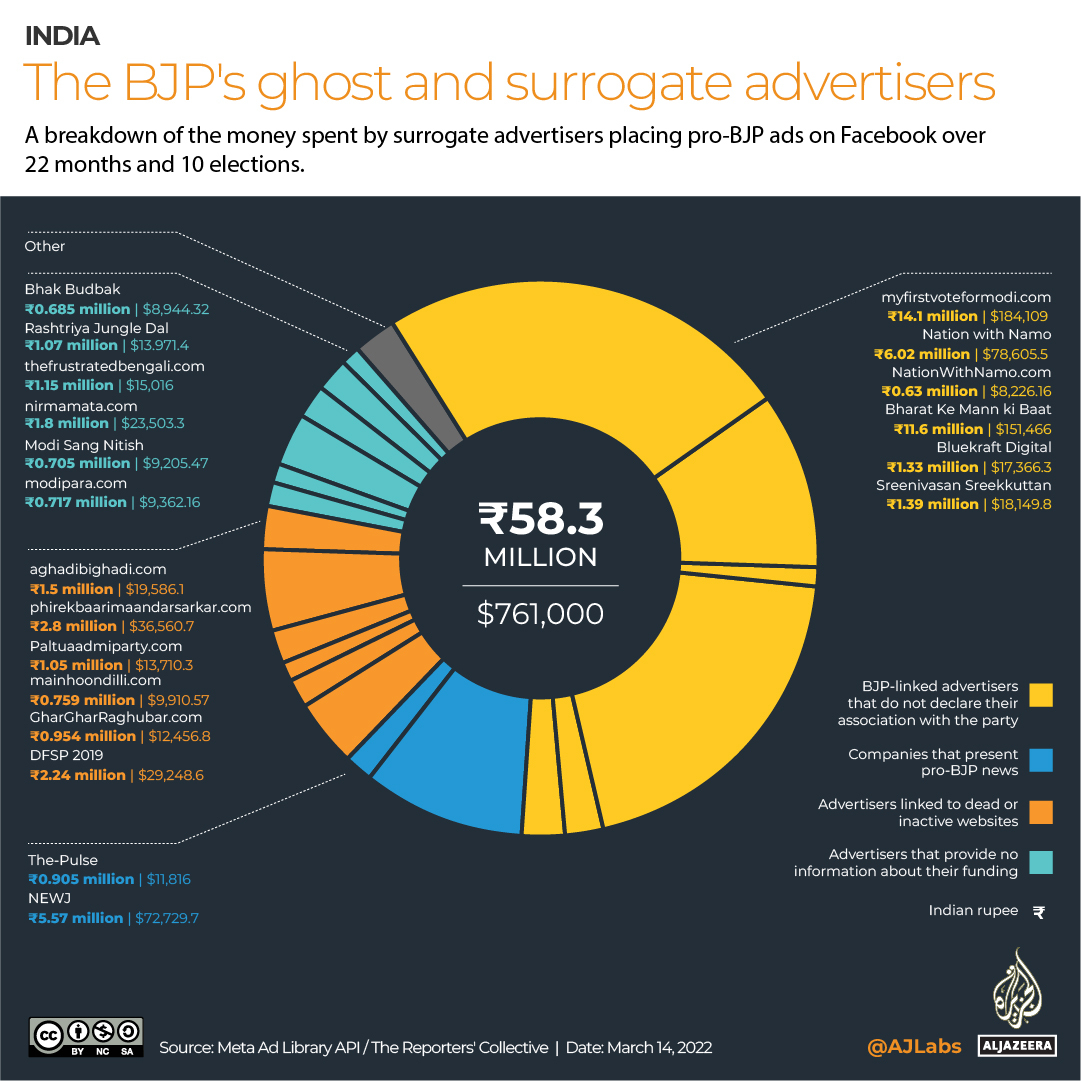
Among the many 23 advertisers that TRC discovered selling BJP with out publicly disclosing any affiliation with the occasion, it might hint six advertisers to the BJP. Advertisers myfirstvoteformodi.com, Nation with Namo, NationWithNamo.com, and Bharat Ke Man ki Baat don’t disclose any formal affiliation with the BJP on their Fb Pages or web sites however listed the BJP headquarters in Delhi as their bodily handle on Fb’s commercial platform (NaMo refers to Narendra Modi). Collectively, these 4 advertisers spent greater than 32.4 million rupees ($423,060) on greater than 12,328 pro-BJP advertisements.

Administrators and chief government of advertiser Bluecraft Digital, which spent 1.33 million rupees ($17,366) on pro-BJP advertisements, labored for the BJP prior to now, whereas advertiser Sreenivasan Sreekkuttan, who spent 1.39 million rupees ($18,150) on pro-BJP advertisements, additionally advertises on the Fb web page of right-wing social-media commentator Abhinav Khare. Khare had been CEO of Asianet Information Community, whose mum or dad firm Jupiter Capital is based by BJP member of parliament Rajeev Chandrashekhar.
Particulars concerning the different 17 advertisers on Advert Library now both result in lifeless web sites or portals that produce pro-BJP ads disguised as information and evaluation, typically with no possession particulars.
In Half 1 of this collection, TRC reported how a Reliance-funded media agency printed a number of ads that disguised unverified or distorted data as information content material to advertise the BJP and Prime Minister Narendra Modi and denigrated their opponents throughout elections. The corporate spent greater than 5.57 million rupees ($72,730) on its ads.
One other portal, The-Pulse, which describes itself as a “media/information firm”, paid 905,000 rupees ($11,817) for Fb ads, a lot of which glorified BJP and Modi with intermittent calls to vote. Neither the Fb web page nor the web site of The Pulse discloses any particulars of who owns and funds its operations.
One Fb web page, Distoy Farak Shivshahi Parat (which interprets from Marathi to “The distinction is seen, Shivaji’s rule is again”), printed 1,748 ads selling the BJP, principally in the course of the Maharashtra state elections in 2019. The advertiser, which spent 2.24 million rupees ($29,249) on these ads, is listed as DFSP 2019 with no particulars of the particular person/organisation related to it. The web site, shivshahiparat.com, listed within the disclosure doesn’t open.
For a lot of different pro-BJP advertisers, the listed funders result in lifeless or inactive web sites within the Advertisements Archive information whilst their Fb pages are lively. These embrace GharGharRaghubar.com (which spent 954,000 rupees or $12,457 throughout Jharkhand elections), mainhoondilli.com and Paltuaadmiparty.com (which spent 759,000 rupees or $9,911 and 1.05 million rupees or $13,710, respectively, throughout Delhi elections), phirekbaarimaandarsarkar.com (which spent 2.8 million rupees or $36,561 in Haryana elections) and aghadibighadi.com (which spent 1.5 million rupees or $19,586 in Maharashtra elections).
Whereas TRC might discover archived pages of a few of these web sites, indicating they have been lively prior to now, it couldn’t decide if any formal affiliation with the occasion was declared then.
Fb has mentioned it takes motion towards advertisers, together with disabling ads or eradicating posts or pages, if it finds they don’t factually characterize their identities and affiliations. However of all of the above advertisers, it disabled ads from just a few pages however solely after these ads had already run, in some instances for so long as 10 days. By the point the ads on My First Vote for Modi, Bharat Ke Man ki Baat, Distoy Farak Shivshahi Parat and Rashtriya Jungle Dal pages have been disabled, that they had already been seen greater than 161.9 million, 145.7 million, 63.2 million and 15.3 million occasions, respectively.
The 2 advertisers who promoted Congress with out disclosing their affiliation with the occasion have been Karan Gupta, who spent 1.48 million rupees ($19,325) on 1,798 ads and Nishant M Solanki, who spent 800,000 rupees ($10,446) on 1,332 ads.
One other web page, Khotikarok Modi, spent 4.9 million rupees ($63,981) on 1,364 ads in detrimental campaigns towards Modi, principally within the West Bengal elections, which acquired greater than 62 million views. And tndeservesbetter.in spent 2.9 million rupees ($37,867) on 839 ads in a marketing campaign towards BJP’s ally All India Anna Dravida Munnetra Kazhagam (AIADMK) in Tamil Nadu state. The ads acquired greater than 53.5 million views.
These have been the advertisers who spent greater than 500,000 rupees ($6,529). There could possibly be surrogate advertisers which have spent smaller quantities however the true scale of surrogate promoting won’t be recognized except Fb and the Election Fee totally study the ads and identities of the advertisers.
How information was accessed and analysed
The Reporters Collective and advert.watch used the Advert Library Utility Programming Interface (API) that Fb gives to advertisers, researchers and market analysts to parse its political ads archive information.
TRC first downloaded information about all political ads positioned till November 18, 2020. There was a complete of 536,070 political ads positioned on this interval.
A complete of 8,359 advertisers (people and organisations) spent 613.73 million rupees ($8.01m) on 454,297 political ads. The remaining ads have been printed with out disclosing the supply of funding. Fb mentioned it took such ads down finally.
For the evaluation, TRC and advert.watch recognized all advertisers who spent greater than 500,000 rupees ($6,529). There have been a complete of 145 such advertisers. They accounted for greater than two-thirds of the full spend on all political ads till then. From this, TRC and advert.watch separated those that had declared their affiliation with events and candidates, from those that had not. Inside the latter class, TRC and advert.watch might map hyperlinks just for some with the political events based mostly on different data just like the declared handle or company data.
The ultimate takeaway from the evaluation was that not solely was the BJP the biggest political advertiser on Fb, however the ads by its surrogates doubled the occasion’s visibility on the platform, leaving Congress, the second-largest advertiser, far behind.
BJP’s advantages usually are not restricted to only Fb permitting surrogate promoting for it. Even Fb’s algorithm works to undercut political competitors in favour of the BJP, as Half 3 of the collection will reveal.
Kumar Sambhav and Shreegireesh Jalihal are members of The Reporters’ Collective and Nayantara Ranganathan is a researcher with advert.watch.
[ad_2]
Leave a Reply