
[ad_1]
Mohamad Othman remembers occurring college journeys to historical archaeological websites in Syria, by no means imagining considered one of them would change into his residence.
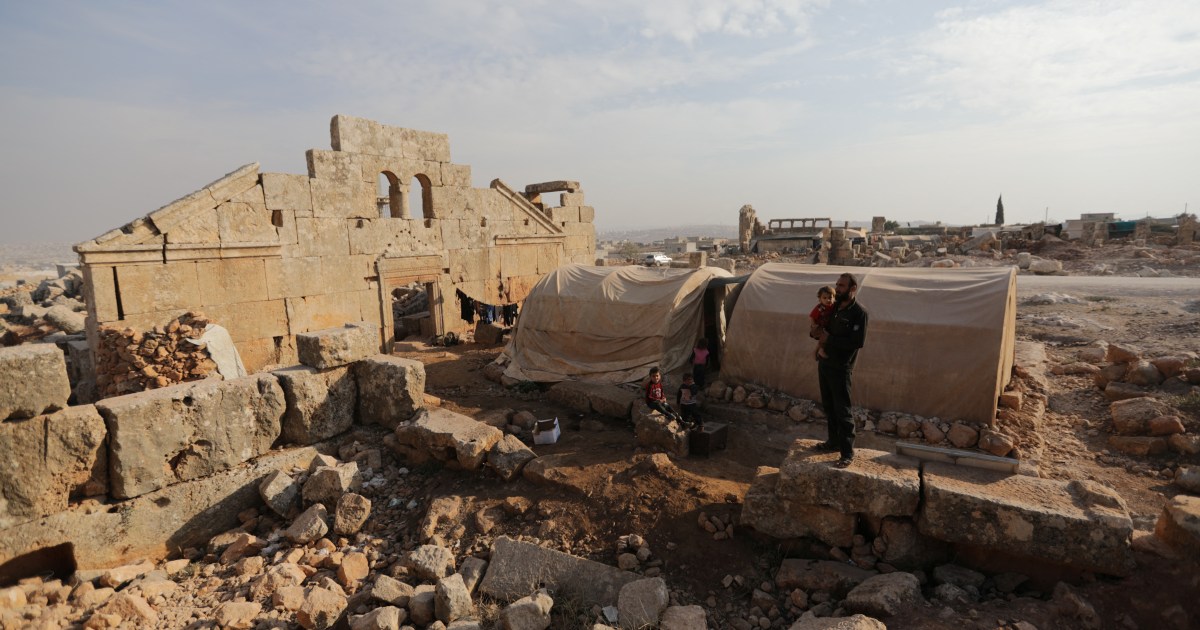
The 30-year-old and his household have been dwelling in a tent amidst historical ruins at Sarjableh close to the Turkish border since fleeing for his or her lives some two-and-a-half years in the past throughout a authorities offensive in northwestern Syria.
Rocks gathered from the positioning anchor down their tent, considered one of a number of dozen which can be sheltering households who’ve fled their houses in the course of the 10-year-old Syrian warfare.
Their garments cling to dry on two strains strung between the tent and an historical stone portico. Their kids clamber over the rocks and stability on partitions on this uncommon, if not harmful, playground.
“In the summertime, we face scorpions, snakes and mud, and all of the pressures of life, and in winter the chilly. The scenario is determined. There are not any well being companies,” Othman stated.
A father of 4, he struggles to make an revenue, relying on seasonal work comparable to olive choosing and some other jobs he can get. When there isn’t any work, he’s pressured to enter debt to offer the fundamentals. His kids don’t go to highschool.
“When the final bombardment and assault started, we left to come back to right here,” Othman stated. “We didn’t discover a place to take shelter, so we lived right here among the many ruins.”
Sarjableh, an early Christian settlement with ruins courting to the fifth century, has been fashionable with the displaced as a result of they don’t have to pay to remain there, not like different areas the place landowners cost lease.
“Everybody right here used to have land that we’d farm and we had livelihoods in our villages and didn’t want anybody. However our destiny was to be displaced,” Othman stated.
“We didn’t depart our land by our personal free will to come back to an space that has been uninhabited for hundreds of years.”
Not removed from Sarjableh, in one other nook of the northwestern province of Idlib, the traditional website of Babisqa can also be offering shelter for these bombed out of their houses.
In an earlier part of the warfare, rebels used the positioning as a base, working from historical caves hewn from the rock the place wiring put in by the opposition fighters can nonetheless be seen.
Livestock farmers, took their sheep and goats with them after they fled into rebel-held areas from the territory now below Syrian authorities management. Right now, sheep and goats feed amid the traditional stones, with poultry pecking on the bottom.
[ad_2]








Leave a Reply