
[ad_1]
Who would have imagined that information of the pandemic – which isn’t over – would get replaced with information of a brand new warfare in Europe? If we’re to go by the shock expressed by so many within the media over Russian President Vladimir Putin’s resolution to launch an all-out invasion of Ukraine, the reply shouldn’t be many.
Truly, there was little cause to be shocked. Simply as many scientists and establishments had been warning {that a} new influenza pandemic was imminent years earlier than COVID-19, many political scientists and journalists, from John Mearsheimer to Pepe Escobar, have lengthy been warning that if NATO continues increasing in the direction of Russia’s borders, a lethal confrontation in Ukraine may very well be on the playing cards.
If the world took these warnings severely, the horrific penalties of each occasions may have maybe been restricted. However over a month into the battle, it feels counterproductive to speak about what may have been or focus on the origins of or motivations behind the warfare. However, it’s vital to grasp why we ended up right here as a result of understanding this may very well be key to resolving it. So who may assist us perceive?
Earlier than we begin naming names, we should perceive that Putin’s longer-term motivations for invading Ukraine are rather more necessary for our functions than the acts and occasions that ultimately led him to offer the order for this “particular navy operation”. Whereas NATO’s continued efforts to encircle Russia, regardless of many warnings from the Kremlin, look like the rapid set off that led Putin to invade, there have been additionally deeper philosophical and ideological motivations behind this invasion – motivations solely sure Russian thinkers may help us perceive. In fact, after seeing the devastation the invasion has introduced upon the Ukrainian individuals, none of those motivations can justify Putin’s actions – however they may help us perceive the various dimensions of the worldwide geopolitical battle between Russia and the West, and assist us provide you with recipes for its decision.
Vladislav Surkov, or “Putin’s Rasputin” as Soviet-born British journalist Peter Pomerantsev as soon as referred to as him in an article for the London Evaluation of Books, is the thinker most generally cited because the ideological mastermind behind Putin’s politics and thus the Ukraine invasion. A protracted-term councillor to the Kremlin, Surkov was the primary ideologist behind the doctrine of Russian “sovereign democracy” that has been guiding the Kremlin since no less than 2006. An authoritarian model of delicate liberalism that offers a whole lot of management over the financial system to the state, Surkov’s sovereign democracy presents itself as a substitute for decadent Western liberalism. A staunch supporter of the “there is no such thing as a Ukraine” narrative, Surkov is extra a political consensus organiser than a thinker, however he’s undoubtedly somebody who performed a major function within the growth of the ideological and philosophical framework that paved the way in which for Putin’s invasion.
Within the eyes of a lot of Putin’s critics, nonetheless, it’s the concepts of Ivan Ilyin not Surkov, that guides the Kremlin’s geopolitical ambitions and that paved the way in which for the invasion. The thinker, who died in exile in Switzerland in 1954, was the primary ideologue of the Russian anti-communist White Motion whose devotees emigrated out of Russia within the wake of the Bolshevik revolution. Ilyin opposed Bolshevism and advocated for a type of Christian authoritarianism much like that of the Francisco Franco regime in Spain. Echoing famend Russian novelist Fyodor Dostoevsky, Ilyin believed Russia had an obligation to protect its conventional autocracy and resist Western liberalism.
Over time, Putin confirmed his admiration for Ilyin in a number of methods. In 2004, he facilitated the thinker’s posthumous repatriation by ordering his stays to be moved from Switzerland to the Donskoy Monastery in Moscow. In 2014, he really useful his regional governors learn Ilyin’s e-book, Our Facet, alongside Justification of the Good by Vladimir Solovyov and Philosophy of Inequality by Nicholas Berdyaev. The factor that tied collectively these three authors, who all had very completely different visions for the way forward for Russia, was their adherence to the “Russian Concept” – a set of ideas expressing the historic uniqueness, particular vocation and international objective of the Russian individuals and, by extension, of the Russian state. And that is no coincidence – in the event you learn by the speeches Putin gave over time that included quotes from Ilyin, you will notice that the Russian President’s curiosity within the thinker had all the time been tied to the “Russian Concept”.
Whereas it’s clear that each Surkov and Ilyin influenced Putin in several methods over time, neither thinker could be credited with constructing the ideological foundations of the Kremlin’s present geopolitical stance and ambitions alone.
So is there a determine who of their thought marries Putin’s authoritarian ideological imaginative and prescient with a philosophy that places Russia on the centre of the historic stage, and could be seen because the architect of a world imaginative and prescient that required the invasion of Ukraine to materialise?
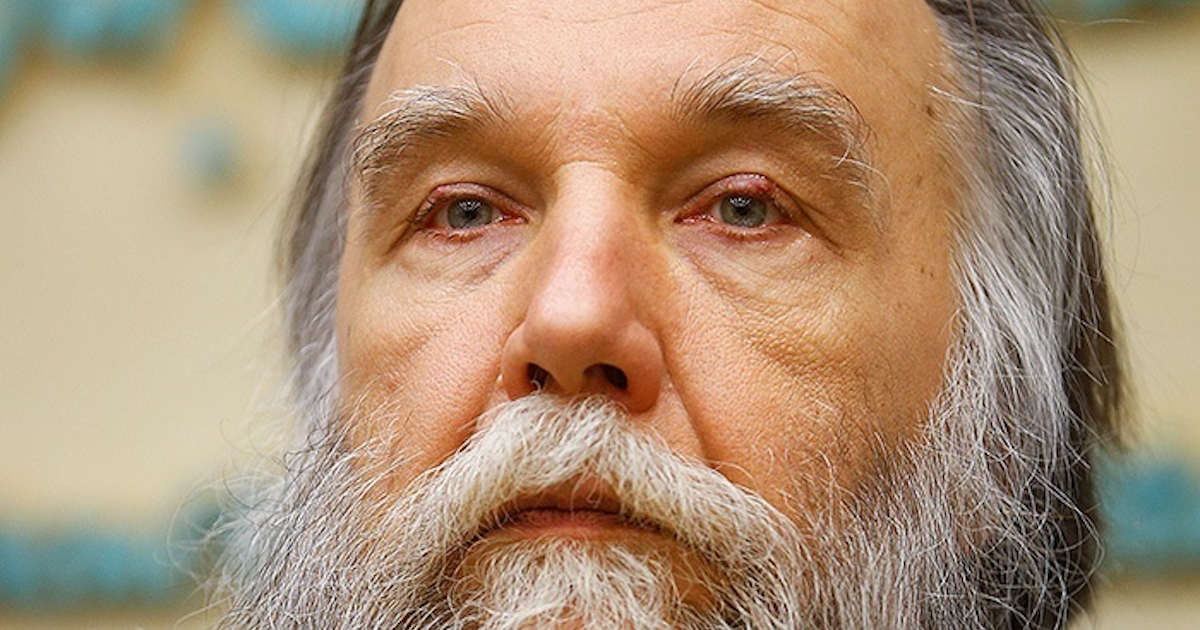
There actually is, and his identify is Alexandr Dugin.
Dugin, who was born in Moscow in 1962, shouldn’t be solely a thinker, political analyst and strategist but additionally one of many main organisers of the ultra-nationalist Nationwide Bolshevik Entrance and the Eurasia Social gathering. These political organisations mix Neo-paganism, Slavic Nativism, and Japanese Orthodox traditions underneath Dugin’s “Fourth Political Concept”, which integrates parts of liberal democracy, Marxism, and fascism in a brand new ideology designed to counter liberalism and its individualist denial of mysticism and traditions. “We’re all,” he as soon as wrote, “towards liberal postmodernity.”
Dugin’s Fourth Political Concept, and the e-book of the identical identify he revealed in 2009, has impressed many within the modern European populist far-right, from Marine Le Pen in France to Matteo Salvini in Italy, and undoubtedly impressed Putin. However, the work by Dugin that impressed the Russian president essentially the most, and maybe guided his resolution to invade Ukraine was his earlier e-book, Foundations of Geopolitics.
Quickly after its publication in 1997, the e-book, which outlined how Russia may reassert itself on the worldwide stage after the collapse of the Soviet Union, grew to become necessary studying in Russian navy universities.
Within the e-book, Dugin argues that to return to its former may, Russia should make sure that “Atlanticism” – the liberalism, free markets and democracy representing North America and Western Europe – loses its affect over “Eurasia” – the territories as soon as ruled by the Soviet Union, which wants to face for hierarchy, custom and a strict authorized construction.
What’s most intriguing is maybe how Dugin suggests Russia ought to push Atlanticism out of Eurasia and regain its international affect. He argues that to attain this objective Russia should “destabilise inner political processes within the US”, encourage Britain’s exit from the European Union and start the annexation of Ukraine.
Whether or not Dugin’s theories actually impressed Putin to intrude – if he interfered in any respect – within the US presidential election and the Brexit referendum in 2016, or inspired him to invade Ukraine in February, is unattainable to establish. However, it’s laborious to disclaim the Russian state’s actions previously few years have been according to Dugin’s philosophy, ideology and geopolitical imaginative and prescient for constructing a Nice Russia.
It’s beautiful how comparable Dugin’s – and maybe Putin’s – view of a world spatially divided between completely different cultures is to the one portrayed by Samuel Huntington within the Conflict of Civilizations (1996). The distinction is that the American social scientist wager on Islamic civilisation turning into the primary challenger to the West. Dugin, nonetheless, is betting on a brand new world order by which Russia is the one countering Western civilisation because the main Eurasian energy.
Whereas NATO’s growth actually performed a task in frightening Moscow to embark on an all-out invasion of Ukraine, it was probably the aforementioned philosophers who put the Kremlin on a path that runs opposite to the predictions Francis Fukuyama made in The Finish of Historical past (1992).
We are going to see within the following months what’s going to come out of the harmful imaginative and prescient of Putin’s philosophers. A peaceable answer to the battle between the West and Russia, nonetheless, is turning into extra elusive with each passing day because the battle in Ukraine additional radicalises either side. Certainly, there’s little indication that both occasion is prepared to enter into good religion negotiations.
It appears as if it was solely yesterday that The New York Occasions’s Thomas Friedman was celebrating the wonders of globalism in his e-book, The World is Flat.
Right now, nonetheless, the bitter judgement Canadian historian Quinn Slobodian made in his 2018 e-book, Globalists: The Finish of Empire and the Delivery of Neoliberalism, rings more true than all else: “The legitimacy crises which have plagued the WTO since its creation counsel that ordoglobalism as a definite pressure of neoliberalism might have overreached. If the objective was to fine-tune the foundations to forestall disruptive calls for for social justice or redistribution, then victory is nowhere in sight.”
The views expressed on this article are the authors’ personal and don’t essentially mirror Al Jazeera’s editorial stance.
[ad_2]
Leave a Reply